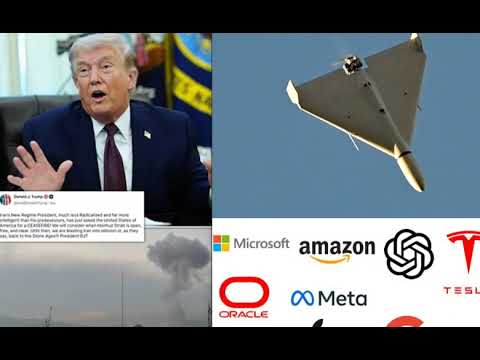
Major US technology companies have been named as potential targets as the Iran war spills into the infrastructure that powers modern economies.
Iranian state media listed 18 companies that will be targeted in the region – the list included US companies Microsoft, Google, Apple, Meta, Oracle, Intel, HP, IBM, Cisco, Dell, Palantir, Nvidia, Tesla, JP Morgan, GE, and Boeing, as well as the UAE’s G42 and Spire Solutions.
“These companies should expect the destruction of their respective units in exchange for each terror act in Iran, starting from 8 PM Tehran time on Wednesday, April 1st,” the IRGC statement said, warning employees to leave their workplaces, and calling the companies “key institutions involved in terrorist espionage operations.”
G42 is a UAE AI company whose investors include the UAE’s Mubadala as well as US entities Microsoft, SilverLake, and the Dalio Family Office. While it has an international presence, it is headquartered in Abu Dhabi.
The company is a major player in the UAE’s AI ecosystem – alongside Mubadala, it co-founded technology investment firm MGX, which has investments and partnerships with AI companies including OpenAI and Anthropic. G42 operates multiple divisions spanning healthcare (M42), sovereign AI and cloud (Core42), and space tech (Space42), among others.
Spire Solutions is a Dubai based cybersecurity company, which works with governments, financial institutions, telcos, energy companies and other businesses in the Middle East and Africa.
Recurring Threats
This isn’t the first threat made against US companies. In early March, Iranian state-linked media published a list of offices and infrastructure run by American companies with Israeli links whose technology has been used for military applications. According to Al Jazeera, the companies include Google, Microsoft, Palantir, IBM, Nvidia and Oracle. None were attacked, though hackers thought to be linked to Iran breached medical tech firm Stryker.
Many of these companies operate regional offices, cloud infrastructure or data-centre operations across the Gulf, including in the UAE.
The list was published by the semi-official, Islamic Revolutionary Guard Corps-linked Tasnim News Agency alongside a warning that the scope of the conflict could expand beyond traditional military targets.
“As the scope of the regional war expands to infrastructure war, the scope of Iran’s legitimate targets expands,” Tasnim News Agency reported.
Early in March, Iranian drone strikes damaged Amazon Web Services (AWS) data centres in the UAE and Bahrain, disrupting services and exposing the vulnerability of physical tech infrastructure in the region.
The warning followed Iranian reports of an Israeli strike on a bank building in Tehran linked to Bank Sepah. Iranian officials have described it as an attack on economic infrastructure.
Iranian state media said the incident justified expanding potential targets to include US and Israeli economic and banking interests across the region.
“With this illegitimate and uncommon action, the enemy is forcing our hand to target economic centres and banks linked to the US and Zionist regime in the region,” said a spokesperson for the IRGC-owned Khatam al-Anbiya Headquarters. He warned civilians to stay one kilometre away from banks.
Tech in Warfare
The tech companies listed by Iran have all been accused of supplying their technology for use by the Israeli military to different extents, though most have refuted these claims. Palantir openly agreed to a strategic partnership with Israel to “help the country’s war effort”, including supplying “advanced technology in support of war-related missions,” Palantir executive vice president Josh Harris told Bloomberg.
But the cloud is not the only digital system being pulled into the conflict. Across the region, electronic warfare targeting GPS signals has surged, disrupting navigation systems used by aircraft, ships and everyday smartphone apps.
Technology companies operating in the region have already begun adjusting their operations. Several US firms with offices across the Gulf have asked employees to work remotely or limit travel as the conflict escalated, according to media reports. Some companies have also activated contingency plans following infrastructure disruptions linked to drone strikes and airspace closures.
Learn More:
https://www.wired.me/story/war-on-big-tech-iran-names-israeli-linked-us-firms-as-potential-targets
Got a news tip or correction? Let us know
If you got something out of this, please chip in to keep this site running, or subscribe to go ad-free.
5 views