Yesterday I looked at the economic struggles of Europe and in particular the Euro area in the light of the optimism generated by The Draghi Report of September 2024. Underlying the malaise has been th struggles of what used to be the regions economic superpower Germany so it was with a wry smile I read this morning’s statistics headline.
WIESBADEN – Gross domestic product (GDP) rose by 0.3% in the second quarter of 2026 compared to the first quarter of 2026 – adjusted for price, seasonal, and calendar effects. As the Federal Statistical Office (Destatis) reports, this increase in economic output was 0.1 percentage points higher than reported in the preliminary release.
So a 0.1% which relates to a question I was asked by Better Statistics last week which is does 0.1% make a difference in economic data? I asked a city trader who had the same answer as me “it depends”. So let us look further.
“The growth momentum of the German economy from the beginning of the year is continuing,” says Ruth Brand, President of the Federal Statistical Office. “As in the first quarter, the increase was primarily due to strong export performance,” Brand added.
That is interesting in that it is against the narrative as for example with the Tariff Wars and the problems in the Middle East one might think there would be issues with exports and imports of various types would be more expensive. But Germany has been on an export drive.
As in the previous quarter, trade with foreign countries increased significantly in the second quarter of 2026, adjusted for price, seasonal, and calendar effects: Exports of goods and services rose by 2.0% compared to the first quarter of 2026, primarily driven by goods exports (+2.6%). Service exports, on the other hand, remained unchanged compared to the previous quarter (0.0%).
So it is goods exports as services ones as a flat as a pancake again not what one would expect in the present situation. We only get a sideways look at what might be driving this.
The manufacturing sector, in particular, saw a significant increase in value added compared to the previous quarter, growing by 0.9%. Economic output increased especially in the production of chemical products and electrical equipment.
With the price changes we have seen I wonder if the methodology here can keep up? But this is the other side of the coin.
While goods imports increased significantly by 2.1%, service imports rose only moderately (+0.3%). Overall, adjusted for price, seasonal, and calendar effects, imports increased by 1.5% compared to the first quarter of 2026.
According to the IEA Germany imported some 70% of its energy in 2024 and energy dependent imports will also be more expensive.
Investment
This is interesting as it does fit yesterday’s theme.
Gross fixed capital formation, on the other hand, declined slightly by 0.2% in the second quarter of 2026, adjusted for price, seasonal, and calendar effects. Investment in equipment – primarily machinery, tools, and vehicles – was significantly lower than in the previous quarter (-1.4%).
Also Holger Zschaepitz of Die Welt pointed out this.
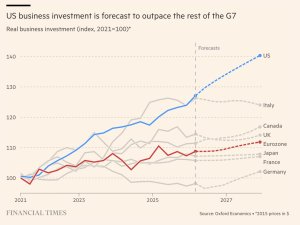
Good Morning from Germany, where business investment is the weakest in the entire G7. Since 2021, investment has essentially stagnated, while the US is powering ahead, driven by the AI boom. By 2028, US real business investment could be up 40%, while Germany remains the G7 laggard. Europe’s investment gap is becoming a growth gap.
The first issue here is one for economic theory because when I was at the LSE back in the day exports and investment were treated like a job lot. Let me also add his chart because you see there are lots of narratives around that the UK would see a boost in investment from rejoining the EU whereas the actual numbers show this.

As you can see that narrative is the opposite of the numbers. Along the way let me give Italy some credit as usually it is under fire.
Government Spending
Germany is supposed to be seeing a fiscal boost and yet we are told this.
Both private and government consumption expenditure increased only slightly, by 0.1% each, compared to the previous quarter.
Also let me add in construction where we are told this.
Economic output in the construction sector remained virtually unchanged (-0.1%). This at least weakened the downward trend of the previous quarters.
Whereas the PMI business survey shows a grimmer picture.
The headline index came in at 42.1 in July, down from June’s 44.8 and its lowest for three months. The index has registered in sub-50 contraction territory throughout the year-to-date,
A Deeper Perspective
We can start with this.
In comparison to the previous year, GDP in the second quarter of 2026 was 1.0% higher in real terms than in the second quarter of 2025. Adjusted for price and calendar effects, the increase was also 1.0%.
The good news is that this represents an improvement as annual growth was 0% at this time last year. The bad news is that this is “Girlfriend in a Coma” territory and if we look back we see depression type numbers. For example adjusted GDP was 105.7 in the second quarter of 2022 and 106.2 in he same quarter this year. So not much growth which depends on the adjustments because the basic number was 104.1 back in 2022 and also 2026.
We’re on a road to nowhere (hey, hey)We’re on a road to nowhere (hey, hey)We’re on a road to nowhere (hey, hey) (Talking Heads)
Ch-ch-changes
We learn something by the simple reality that even the Financial Times can not avoid issues like this.
Sembach, a family-run ceramics company based in Bavaria, has been making parts for the auto industry since the 1970s, including sensors used in combustion engines. But with an end to fossil fuel-powered cars coming into view and Europe’s car manufacturers under increasing pressure from Chinese electric-vehicle makers, Sembach is making a pivot from motors to medical tech.
Firstly let me wish all those at Sembach well. But the excuses around fossil fuel cars is a Financial Times smokescreen because if you follow my China updates you will know it has economically run rings around Europe and Germany in particular. The next bit makes you wonder where the reported export boom has come from?
“We’re currently witnessing a shift,” said Anna Sembach, the 35-year-old chief executive of the family business and its founder’s great-great-granddaughter. “You can really see that production volumes, especially in the European market, have dropped significantly.” The company, based in Lauf an der Pegnitz near Nuremberg, manufactured on average about 600mn small parts a year for the auto industry until recently. Now the number is closer to 400mn.
Whilst I wish the company below well too are they not moving into an area of Chinese strength?
Schaeffler is now adapting gears and sensors it made for the auto industry for use in humanoid robots
Comment
Many forget that even depressions have better phases. The real issue is what can really change things? For Germany a major factor is energy but it has locked itself into high electricity prices which make much of its industry uncompetitive. I am sure that some specialist areas can do well. But as we stand the bulk mass production of vehicles looks like it is ending.
Also if we return to the GDP release you can be positive about productivity from the numbers below.
Economic output in the second quarter of 2026 was generated by approximately 45.7 million employed persons working in Germany. This was 212,000 people (-0.5%) fewer than in the second quarter of 2025. Employment in the service sector declined for the first time since the COVID-19 pandemic.
But at the price of jobs.
Got a news tip or correction? Let us know
If you got something out of this, please chip in to keep this site running, or subscribe to go ad-free.
84 views