Something weird is happening with the American consumer.
People are still spending.
But they’re starting to feel bad about it.
A new survey of more than 5,000 Americans found that 72% feel guilty spending money on things that make them happy when those purchases compete with their financial goals.
That’s a pretty good description of where the consumer is right now.
You can still buy the concert ticket.
You can still go to the restaurant.
You can still take the vacation.
But now you’re looking at the credit card bill thinking:
“Was that really worth it?”
And the inflation data explains why.
The Fed’s preferred inflation gauge rose 3.7% over the past year in July.
Core PCE was 3.3%.
The Fed wants 2%.
We’re nowhere close.
And this isn’t just some abstract inflation number.
It’s showing up in the things people actually buy.
Housing.
Insurance.
Food.
Energy.
Services.
Everyday expenses keep taking a bigger bite out of the paycheck.
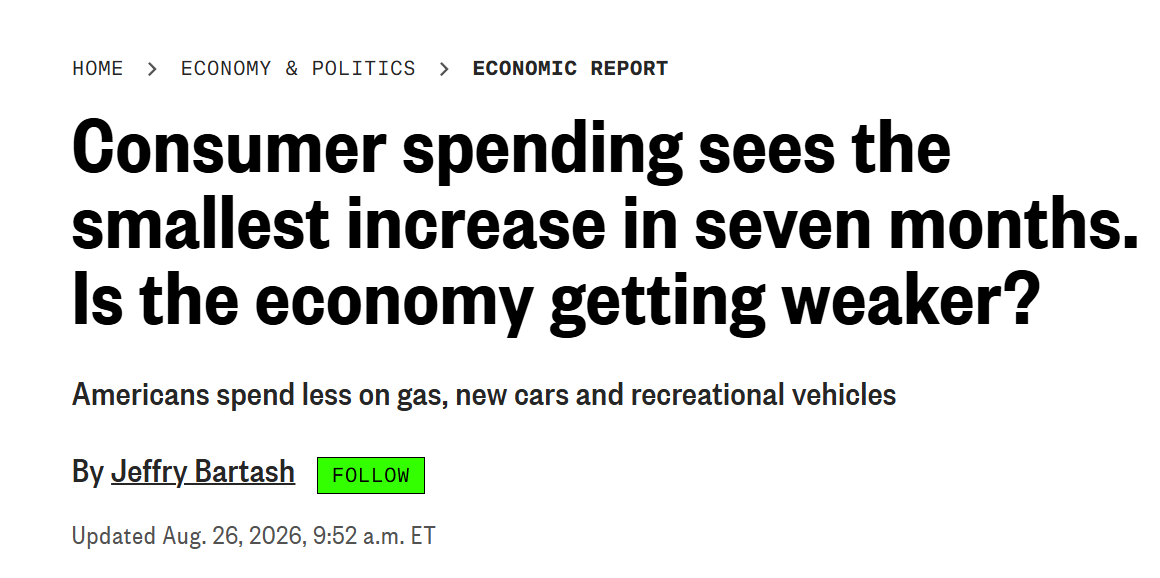
Meanwhile, July consumer spending increased only 0.2%, the smallest increase in seven months.
Personal income did better, rising 0.4%.
But the savings rate also climbed from 2.6% to 3%.
That tells me something.
People aren’t necessarily stopping spending.
They’re becoming more selective.
They’re thinking harder about where the money goes.
And that’s exactly what the “joy spending” survey picked up.
The average American isn’t saying:
“I’m never going out again.”
They’re saying:
“I want to enjoy my life, but I also need to save money.”
That’s a very different consumer.
And it matters because consumer spending is roughly two-thirds of the U.S. economy.
If people start cutting the discretionary stuff first, the damage doesn’t show up immediately.
It starts with restaurants.
Then entertainment.
Then travel.
Then clothing.
Then furniture.
Then all the little purchases people make when they don’t feel financially stressed.
One purchase doesn’t matter.
Millions of households making the same decision does.
And there’s already evidence that Americans are cutting back.
Nearly 39% say they’ve given up or reduced things they enjoy because of the economy.
That’s not a recession by itself.
But it’s exactly the kind of behavior that can turn into one if incomes stop keeping up.
And that’s the part I find interesting.
The economy is still growing.
Q2 GDP was revised to 1.5%.
Consumer spending was actually strong in Q2, rising at a 3.4% annualized rate.
But July spending slowed sharply to 0.2%.
So we’re getting this strange combination:
Prices still rising.
Income still rising.
Spending still positive.
Savings starting to recover.
But consumers increasingly worried about what they can afford.
That can last for a while.
People can cut a $7 coffee before they stop paying the mortgage.
They can skip a vacation before they stop buying groceries.
They can eat at home more often before they stop paying the electric bill.
That’s why consumer weakness can hide underneath decent headline spending for quite a while.
The first thing that disappears isn’t necessarily spending.
It’s freedom to spend.
And that’s what the guilt data is really telling us.
When 72% of people feel guilty about spending on things they enjoy, the problem isn’t simply that Americans have stopped buying.
It’s that the psychological relationship with money is changing.
People are starting to treat discretionary spending like a luxury.
And there’s another problem coming from the inflation side.
The latest PCE report showed inflation staying well above target even while consumer spending cooled.
That’s an ugly combination.
If inflation were falling quickly, the Fed could simply cut rates and let households breathe.
If spending were exploding, you could argue consumers are strong enough to absorb higher prices.
But when spending slows while inflation stays at 3.7%, the Fed gets a much harder problem.
The consumer is getting squeezed from both sides.
Things still cost more.
And people are becoming more careful about spending.
That is why I don’t think the next consumer slowdown necessarily begins with Americans suddenly running out of money.
It can begin much more quietly.
People stop upgrading the phone.
They cook dinner instead of ordering out.
They take one vacation instead of two.
They cancel the subscription.
They wait another year to replace the car.
They skip the concert.
They tell themselves they’ll do it next month.
Multiply that across 100 million households.
That’s when “consumer resilience” starts looking very different.
Americans aren’t refusing to spend.
They’re starting to ask whether they can afford to enjoy spending.
And that may be one of the clearest signs yet that the cost-of-living problem isn’t just showing up in inflation statistics.
It’s changing how Americans live.
Got a news tip or correction? Let us know
If you got something out of this, please chip in to keep this site running, or subscribe to go ad-free.
37 views