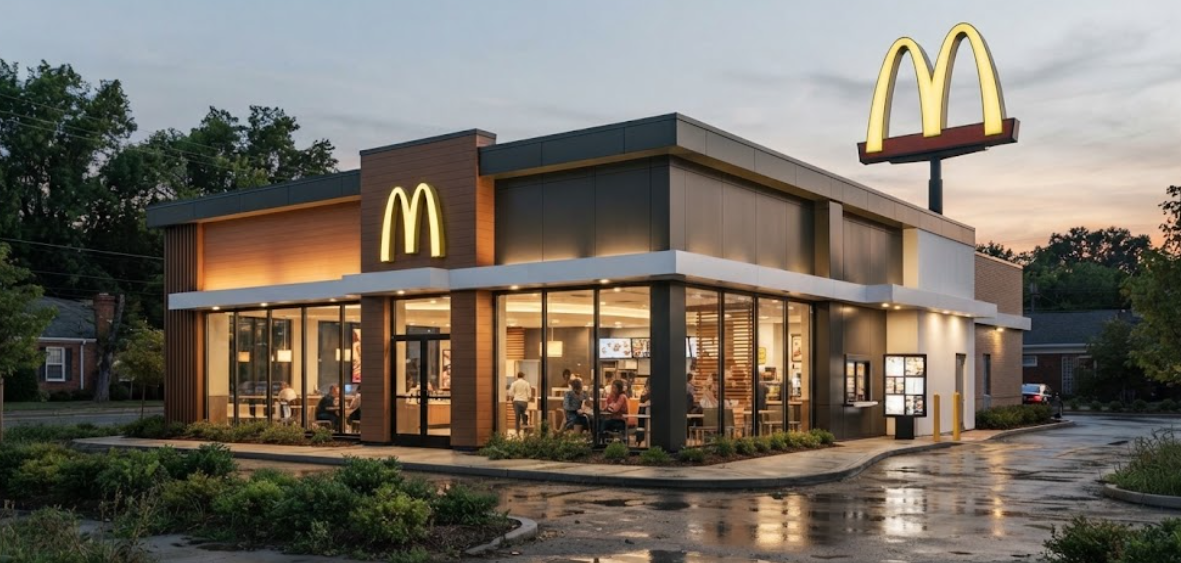
McDonald’s has reached a level where the stock is starting to look less like a growth story and more like a turnaround trade.
That distinction matters.
MCD has fallen roughly 20% this year and recently traded around $234, back near a price zone last seen in 2024. U.S. traffic has been weak, lower-income customers have pulled back, and inflation is still squeezing the value equation at the restaurant counter.
There is no shortage of reasons to dislike the stock here.
That is exactly why the company’s new turnaround plan deserves a closer look.
McDonald’s has just committed roughly $8.5 billion through 2036 to support franchisees as it rolls out NEXT, including about $5 billion through 2030. The company says the program should eventually produce about $100,000 of annual cash-flow improvement for the average U.S. restaurant, with an estimated four-year payback for franchisees after McDonald’s support.
That is not a small menu refresh.
It is a company-wide attempt to change the economics of thousands of restaurants at a time when the existing model is under pressure.
And McDonald’s has been here before.
The last time MCD looked this broken
Go back to 2002 and early 2003.
McDonald’s was coming off a brutal period. Worldwide comparable sales fell 2.1% in 2002 after declining 1.3% in 2001. In the first quarter of 2003, U.S. comparable sales were down 2%, Europe was down 4.4% and APMEA was down 8.3%. Restaurant margins were falling too.
Management had to close underperforming restaurants, cut costs, abandon projects and rethink the entire growth strategy. The old formula of simply adding more restaurants was no longer enough.
Then McDonald’s made a drastic change.
It called the new strategy Plan to Win.
Instead of focusing on getting bigger by opening more restaurants, McDonald’s said it would focus on getting more sales from the restaurants it already had.
The company cut capital spending, concentrated resources on restaurant-level execution and centered the plan around five things: people, product, place, price and promotion.
The timing is worth remembering.
McDonald’s did not wait until the turnaround was obvious.
The stock and the business began improving while the situation still looked ugly.
By July 2003, only months into the new strategy, U.S. comparable sales jumped almost 10%. McDonald’s said the combination of food, service and value initiatives was already improving the customer experience.
By the end of 2003, worldwide comparable sales had gone from a 2.1% decline to a 2.4% increase. Revenue rose 11%. Restaurant margins improved. Management called the year a watershed.
The following year brought another wave of improvement. By February 2004, McDonald’s reported its tenth consecutive month of worldwide comparable-sales increases, with U.S. comparable sales up 20% that month.
The turnaround eventually became one of the company’s defining strategic successes.
Now look at 2026
The circumstances aren’t identical.
That’s actually why the comparison is useful.
McDonald’s isn’t fighting the same problems it faced in 2002. It is fighting a modern version of the same basic problem: customers are not visiting often enough, and the company needs to make its restaurants more attractive without destroying the economics of the franchise system.
The current numbers look bad enough to make the comparison uncomfortable.
U.S. traffic has been under pressure. Prices have risen. Lower-income customers have become more selective. McDonald’s has acknowledged that elevated inflation could keep traffic flat.
And then management unveiled NEXT.
The plan includes restaurant modernization, technology, operational improvements and financial support for franchisees. McDonald’s estimates roughly 250 basis points of restaurant-level efficiency improvement, equivalent to about $100,000 of annual cash-flow benefit for the average U.S. restaurant.
This is where the stock setup gets interesting.
The market doesn’t need NEXT to work perfectly.
It needs evidence that the deterioration has stopped.
That’s a much lower hurdle.
If traffic stops getting worse, if restaurant economics improve and if the first remodeled locations start producing better sales and margins, investors don’t have to wait until 2030 to change their view of MCD.
That is exactly what happened during Plan to Win.
The stock did not need the entire turnaround delivered before the market began recognizing the change. The operating numbers started changing first.
The market is staring at the bad numbers
That is understandable.
But the market may also be looking backward.
At roughly $234, MCD is back around a price area that previously mattered. Meanwhile, management has responded to the deterioration with an unusually large, explicit capital and franchisee-support program.
That creates a very different setup from a stock simply falling because the business is deteriorating.
The company is falling while management is already trying to force a change in the underlying economics.
That doesn’t mean $234 is a guaranteed bottom.
It means the risk/reward equation has changed.
A stock can bounce before the turnaround is proven.
In fact, that is usually when turnaround stocks bounce.
The first move comes from investors deciding the worst-case scenario is already reflected in the price. The second move comes if the numbers eventually prove them right.
McDonald’s has already supplied the first ingredient: a beaten-down stock.
Now it needs the second: evidence that NEXT is working.
Watch the traffic, not the headlines
For MCD, I would watch a few numbers much more closely than RSI.
U.S. comparable sales.
U.S. guest traffic.
Restaurant-level margins.
Franchisee cash flow.
And eventually, the performance of restaurants that have actually gone through the NEXT investment.
If those numbers turn before the broader consumer story improves, the stock could move considerably before Wall Street starts calling it a turnaround.
That is the historical lesson.
In early 2003, McDonald’s looked like a company with a broken formula.
Then management changed the formula.
Today, McDonald’s once again looks like a company with a broken formula in parts of its U.S. business.
This time, management is putting $8.5 billion behind the fix.
The stock is sitting near a four-year low.
The business still looks ugly.
That may be exactly why MCD is starting to look like a bounce candidate rather than simply another falling consumer stock.
Not financial advice.
Got a news tip or correction? Let us know
If you got something out of this, please chip in to keep this site running, or subscribe to go ad-free.
1 view