Social Security is designed to give low-income workers a much better return. And the numbers show just how much better.
People keep arguing that the wealthy are getting a free ride while low-income workers get cheated. But have they looked at what people actually get back from Social Security?
A CBO analysis cited by the Committee for a Responsible Federal Budget found that retirees in the lowest income group are scheduled to receive benefits worth 266% of the payroll taxes paid by them and their employers. The middle-income group gets 147%. The top-income group gets about 100%.
That’s $2.66 back for every dollar paid by the lowest-income group, compared with roughly $1 for the highest-income group.
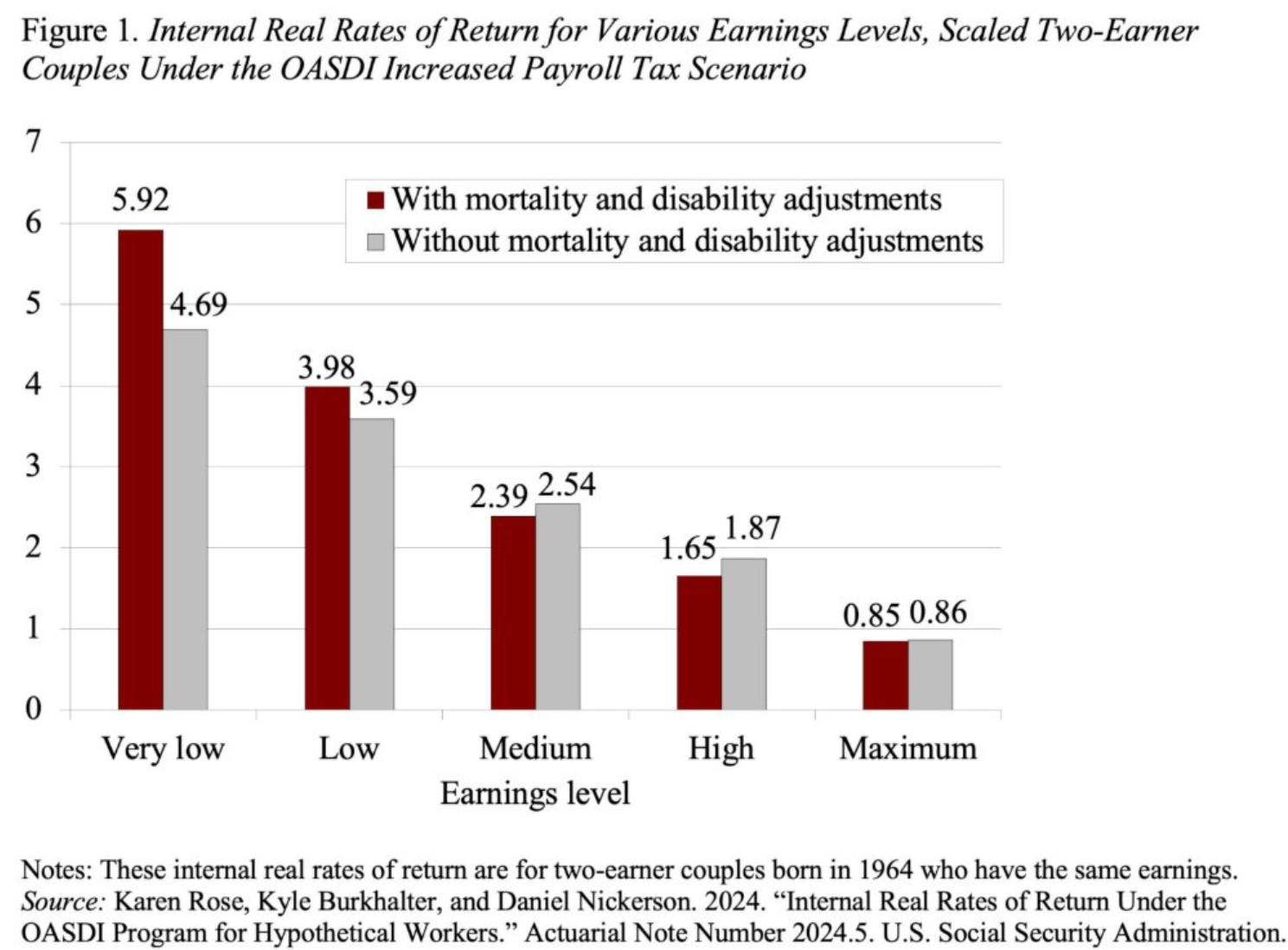
The Social Security Administration has another study that gets even more interesting. It calculated the real rate of return for two-earner couples born in 1964. Even after accounting for differences in life expectancy and disability, the results were:
Very low earners: 5.92%
Low earners: 3.98%
Medium earners: 2.39%
High earners: 1.65%
Maximum earners: 0.85%
That’s a massive difference. The very-low-income couple gets almost seven times the return of the maximum-income couple. This isn’t some accident. Social Security deliberately gives lower earners a better deal. The first portion of their average earnings is replaced at 90%, compared with just 15% for earnings in the highest bracket.
Now, about eliminating the income cap.
In 2026, Social Security taxes only the first $184,500 in wages. Someone earning $2 million pays $11,439 in employee tax, and the employer pays another $11,439. Someone earning $100,000 pays the full 6.2% on every dollar.
But there’s a catch people need to understand. If Congress removes the income cap and doesn’t give additional benefit credits for those newly taxed earnings, high earners will pay more without getting a higher Social Security benefit in return. If they do get additional credits, the program won’t collect as much extra money.

If the cap goes, someone making $2 million could end up paying Social Security tax on nearly $1.8 million more in wages. If those extra earnings don’t count toward benefits, they pay the tax and get no extra retirement money from it. That’s a lot of money going into a system where their own benefit doesn’t go up.
https://www.ssa.gov/oact/cola/bendpoints.html
https://www.ssa.gov/oact/solvency/provisions_tr2025/payrolltax_summary.html
h/t Mark
If you got something out of this, please chip in to keep this site running, or subscribe to go ad-free.
0 views