
The craziest part about U.S. healthcare is not just the price.
It is how much of the money goes into running the machine itself.
America spends $5.3 trillion a year on healthcare.
And roughly 25% to 34% of that spending goes toward administration.
That means more than $1 trillion is tied up in billing, paperwork, insurance layers, management, compliance, and the giant financial system built around healthcare.
That alone is larger than the entire budgets of many countries.
And then you look at the headline number.
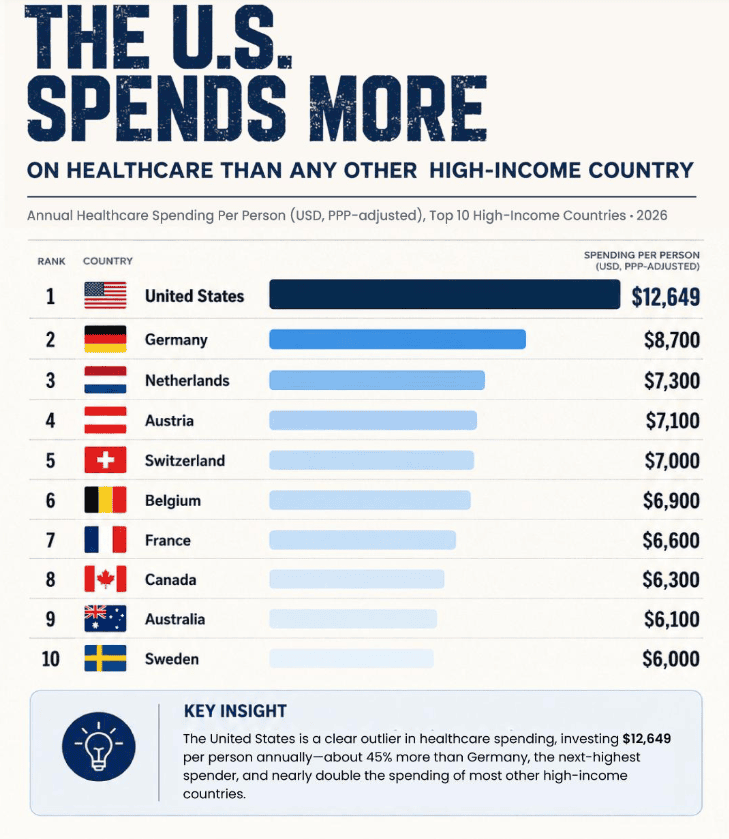
The U.S. spends $12,649 per person every year.
Germany is next at about $8,700.
America is spending roughly 45% more than the runner-up.
The Netherlands spends around $7,300.
Austria around $7,100.
Switzerland around $7,000.
Most wealthy countries are sitting around the $6,000 to $6,900 range.
The U.S. is not slightly more expensive.
It is operating in another universe.
Healthcare now consumes nearly 18% of U.S. GDP.
The average among other high-income countries is around 9% to 10%.
Almost double.
But here is where the system starts looking strange.
The growth has not just been in doctors or treatments.
The healthcare machine itself has exploded.
Healthcare managers reportedly grew around 660% to 800% since 1970.
Doctors only roughly tripled.
The system created an enormous layer whose job is often managing the complexity created by the system.
And patients are still stuck with the bill.
Around 8% of Americans remain uninsured, roughly 27 million people.
Among OECD countries, only Mexico ranks worse.
Then there is the pricing game.
A patient can see an $11,000 emergency room bill become $800 with cash payment.
A $15,000 test can become $400.
At some point people start asking:
If the real price can suddenly change depending on who is paying, what was the first price?
That is where the middleman problem comes in.
Insurance companies.
Hospitals.
Pharmacy networks.
Drug companies.
Everyone has a piece of the system.
Everyone has a reason to protect their piece.
Doctors are part of another incentive problem.
The U.S. performs more scans and MRIs than many countries because defensive medicine is common.
Ordering another test can feel safer than dealing with a lawsuit later.
At the same time, physician supply is restricted by training bottlenecks and residency limits, while some specialists earn 3 to 4 times more than European doctors.
So the system keeps producing the same outcome.
More money goes in.
More layers appear.
Bills keep rising.
Patients keep wondering where all the money went.
The strange part is not that nobody knows healthcare is expensive.
The strange part is that almost every major player benefits from keeping a system nobody can easily understand.
Commonwealth Fund full 2026 report: https://www.commonwealthfund.org/publications/issue-briefs/2026/may/us-health-care-global-perspective-2026
PDF exhibits from report: https://www.commonwealthfund.org/sites/default/files/2026-05/PDF_Gunja_us_health_care_global_perspective_2026_Exhibits.pdf
Got a news tip or correction? Let us know
If you got something out of this, please chip in to keep this site running, or subscribe to go ad-free.
28 views