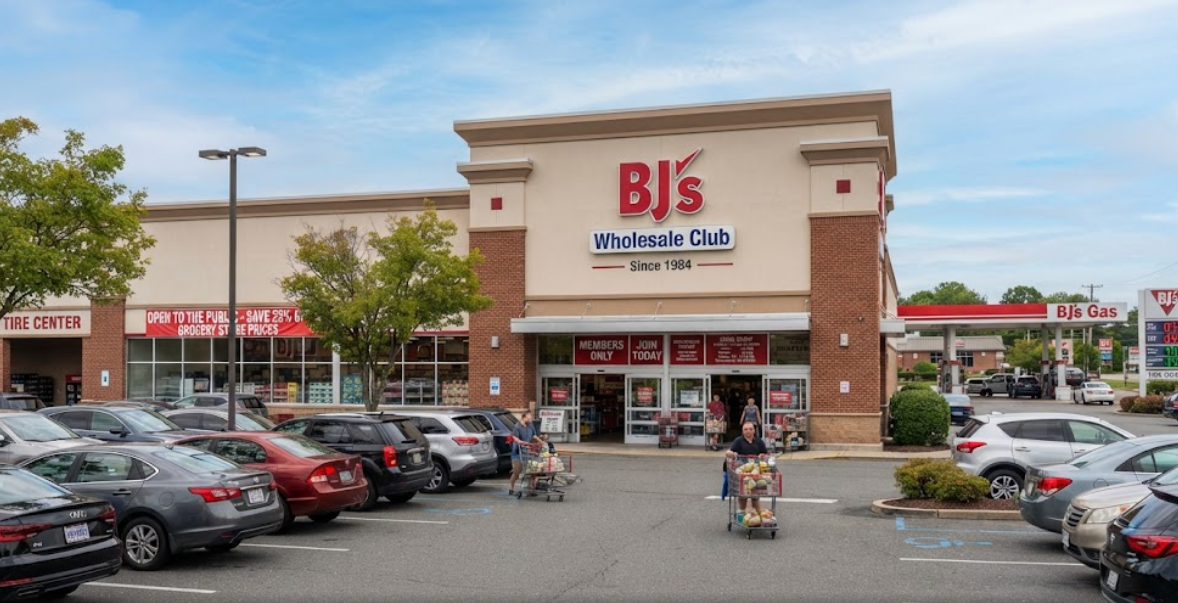
I’m buying BJ because I think the setup is getting unusually interesting.
Not because it’s the next AI stock.
Actually, partly because it isn’t.
1. Risk-off money needs somewhere to go
If the market starts selling high-beta growth and crowded tech positions, investors don’t necessarily leave stocks altogether.
Some money moves toward businesses with predictable demand.
Food.
Gas.
Household essentials.
BJ fits that trade.
Consumer defensive stocks have historically held up better when markets get ugly, and strategists are already pointing to defensive businesses as investors become more selective.
2. AI hype doesn’t need to crash for BJ to benefit
The AI trade has absorbed an enormous amount of investor attention and capital.
If investors start questioning AI valuations, AI capex or the payoff from all that spending, the money doesn’t disappear.
It has to find another home.
I’d rather own a company selling groceries and gasoline to 8.5 million members than another company whose valuation depends on the next AI spending cycle.
3. BJ’s customers are already voting with their wallets
Q2 net sales jumped 15.9% to $6.09 billion.
Total comparable club sales rose 11.9%.
Even stripping out gasoline, comps still increased 3.1%.
That’s important because the business isn’t relying entirely on higher gas prices to manufacture growth.
4. Membership is becoming a recurring cash machine
BJ ended Q2 with a record 8.5 million members.
Membership fee income increased 9.9% to $135.6 million.
And management specifically attributed the growth to new member acquisition, retention and more members taking higher-tier memberships.
That gives BJ something ordinary supermarkets don’t have.
People pay BJ before they even buy the groceries.
5. Digital isn’t a side show anymore
Digitally enabled comparable sales jumped 30% in Q2.
Two-year stacked growth was 64%.
That’s a pretty big number for a warehouse retailer.
BJ doesn’t need to become Amazon.
It just needs its existing members to increasingly use BJ’s digital ecosystem.
6. The value proposition gets stronger when people feel poorer
BJ says its members can save up to 25% on a representative basket of branded groceries versus traditional supermarket competitors.
If households start cutting discretionary spending because inflation, rates or unemployment become a bigger problem, they still need food.
The question becomes:
Where can I get more for the same $100?
That’s exactly the question BJ wants customers asking.
7. Profit is growing faster than the business
Q2 adjusted EBITDA rose 14.3% to $347.2 million.
Net income rose 15.4%.
Adjusted EPS jumped 19.3% to $1.36.
That’s what I want to see.
Not just more revenue.
More earnings coming out of that revenue.
8. They’re buying back the stock
BJ repurchased 1.38 million shares for $124.1 million in Q2.
For the first six months, it bought back 3.50 million shares for $330.7 million.
There was still roughly $422 million left on the authorization.
So while the company is opening clubs and investing in growth, it’s also reducing the share count.
9. There is still a lot of physical expansion left
BJ now has 267 clubs and 206 gas locations across 22 states.
It opened three new clubs and another gas station in Q2.
And it expects roughly $800 million of capital spending this fiscal year for new clubs and distribution infrastructure.
The story isn’t dependent on squeezing more money out of the same 267 stores forever.
There is still room to add locations.
10. The stock doesn’t need a miracle
Management raised full-year adjusted EPS guidance to $4.60–$4.80.
At roughly $91–$93 a share, that’s around 19–20x forward earnings.
That’s not cheap.
I’m not pretending it is.
But I also don’t need BJ to grow 30% a year.
I need a business with recurring membership revenue, growing traffic, expanding stores, strong digital sales and relatively predictable demand to keep compounding earnings while money potentially moves away from speculative growth.
And there’s one more thing I like.
BJ’s Q2 merchandise gross margin actually fell about 20 basis points.
That’s because management is deliberately investing in lower prices.
In other words, they’re giving up a little margin to make the value proposition stronger.
If that brings in more members, more traffic and more volume, the lower margin may be worth it.
That’s the bet.
AI can lose its hype.
The market can go risk-off.
Consumers can become more price conscious.
BJ doesn’t need any of those things to happen.
But if they do?
I’d rather be standing here than chasing whatever stock is currently being sold as the next AI revolution.
Disclaimer: This is not financial advice and is for educational purposes only. Please conduct your own due diligence.
Got a news tip or correction? Let us know
If you got something out of this, please chip in to keep this site running, or subscribe to go ad-free.
50 views