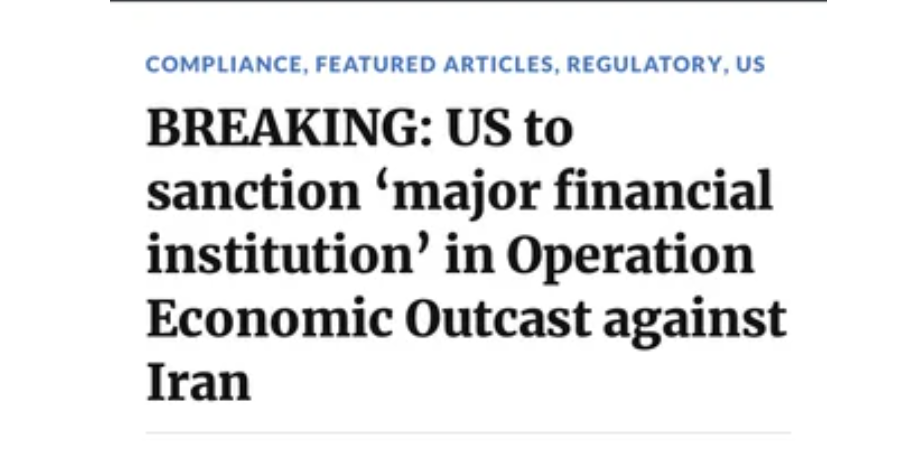
Scott Bessent just launched Operation Economic Outcast against Iran.
Treasury hit nearly 60 entities, individuals and vessels tied to Iranian oil, shadow fleets and financial networks spanning China, Hong Kong, the UAE, Singapore, Switzerland and Europe.
Then Bessent dropped the part that really matters.
He said:
A major financial institution is expected to be sanctioned by the end of this week.
He refused to name it.
He didn’t even give the country.
So now everyone is guessing.
And the guesses matter because this isn’t just another Iran sanctions package.
Treasury has already been sanctioning Iranian banks, shell companies, oil traders and vessels for years.
This time Bessent is threatening to go after a major financial institution.
That’s a different level.
And there’s a clue in what Washington didn’t do on Monday.
The first round did not target the major Chinese financial institutions that help facilitate Iran’s oil trade.
Reuters says that omission disappointed some analysts because China remains Iran’s biggest economic lifeline.
China is the obvious pressure point.
Beijing remains Iran’s biggest oil customer.
And Bessent was asked directly whether Chinese banks financing Iranian oil imports could be targeted.
His answer was basically:
Nobody is above U.S. sanctions.
That’s the part I’d watch.
Because if the mystery institution turns out to be a major Chinese bank, this isn’t simply an Iran story anymore.
It’s a U.S. versus China financial confrontation.
And Washington knows exactly what that means.
A major Chinese bank being cut off from the U.S. financial system would be vastly different from sanctioning another Iranian intermediary.
It could force companies and banks around the world to reconsider whether they can continue dealing with that institution without risking their own access to dollars.
That’s precisely what secondary sanctions are designed to do.
Bessent said any entity facilitating money laundering for Iran will be removed from the U.S. dollar system.
And he made clear the administration is expanding secondary-sanctions exposure beyond traditional oil transactions into digital assets, gold, technology, aviation and shipping.
That’s a much bigger net.
And the U.S. isn’t just targeting Iran anymore.
It’s targeting the companies and financial institutions that keep Iran connected to the rest of the world.
We’ve already seen the pressure spreading.
The new sanctions hit networks operating across multiple jurisdictions, including European and Swiss-linked entities.
Bessent also specifically said Bank Melli’s branches across the Gulf must be “shuttered and dark.”
And Washington is warning countries that continue doing business with Iran that they could face secondary sanctions.
That’s why the mystery institution is so important.
Because the first wave tells us what Treasury can reach.
The next announcement tells us how far Washington is willing to go.
There is already a debate over whether the campaign is actually strong enough.
Reuters Breakingviews made the point bluntly: if Washington really wanted to match the “Economic D-Day” rhetoric, the obvious escalation would be a major Chinese or UAE bank.
That puts Bessent in an interesting position.
If the mystery institution is relatively small, the market probably shrugs.
If it’s a major European or Swiss institution, that’s a serious warning to Western banks still touching Iranian networks.
But if it’s a major Chinese or UAE bank, suddenly the consequences become much bigger.
Because then Washington isn’t just choking Iran.
It’s forcing another major economy to choose between maintaining its relationship with Tehran and maintaining access to the U.S.-dominated financial system.
And China is already pushing back.
Beijing has warned that U.S. sanctions threats over Iranian trade are unacceptable and says it will protect its national interests.
That’s where this gets dangerous.
The U.S. wants to cut Iran’s remaining financial lifelines.
China wants to keep buying Iranian oil.
The UAE has already moved to suspend economic and financial transactions with Iran.
And Iran is still fighting to keep its economy functioning despite the pressure.
So the next announcement isn’t just about which bank gets sanctioned.
It’s a test of how much financial pressure Washington is willing to put on its own allies and major trading partners to isolate Iran.
And Bessent deliberately left everyone guessing.
That’s probably not accidental.
The threat itself creates pressure before the sanction arrives.
Every bank with Iranian exposure now has to ask:
Am I the one he’s talking about?
And every company dealing with Iran through a foreign bank has to ask:
If that bank gets cut off from dollars, what happens to us?
That’s the weapon.
The name of the bank will tell us who got caught.
But the country behind that bank will tell us how far this confrontation is really going.
Because if Bessent sanctions another Iranian-linked shell network, that’s more of the same.
If he sanctions a major European institution, that’s a serious escalation.
If he sanctions a major Chinese or UAE financial institution…
that’s when Operation Economic Outcast becomes something much bigger than an Iran sanctions campaign.
Disclaimer: This is not financial advice and is for educational purposes only. Please conduct your own due diligence.
Got a news tip or correction? Let us know
If you got something out of this, please chip in to keep this site running, or subscribe to go ad-free.
290 views