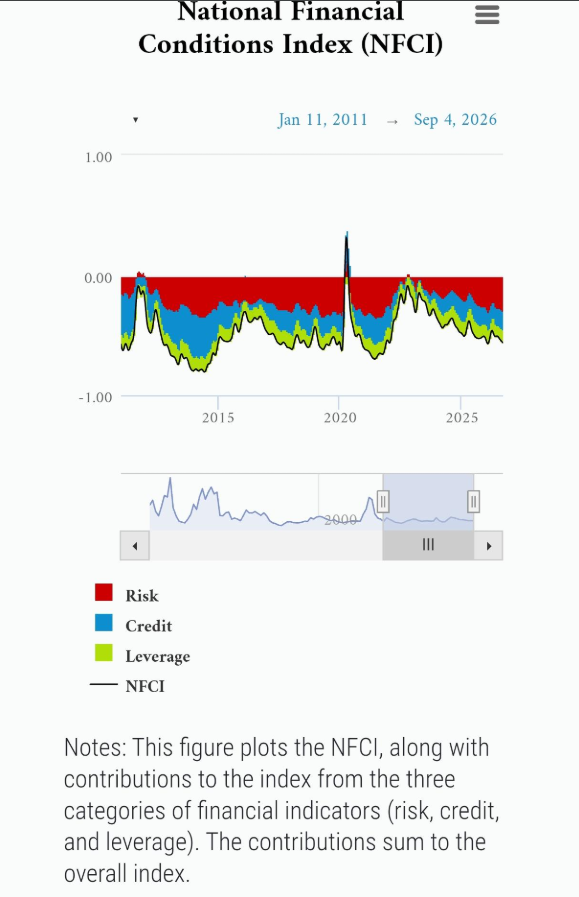
The US national financial conditions index is quite loose recently. But unlike the post-2008 era, today’s relatively loose conditions are driven less by credit expansion and more by low risk premia. This means upstream tech companies can get capital easily, but it isn’t translating into household balance sheet expansion through the traditional “financial accelerator” mechanism to the same extent.
In the post-2008 era, easing was more driven by credit expansion. Housing prices rebounded, higher collateral values enabled households to borrow more.
This time, transmission to the consumer appears weaker. While aggregate household wealth has increased, it hasn’t translated into the same kind of broad collateral-driven credit expansion. Without the “finance-supply-demand” flywheel, this cycle is more concentrated upstream.
When risk premia normalize, financial conditions could tighten much faster than they did during much of the 2010s.
The credit market is not worried. That tells you more than the daily noise.
The spread between investment-grade corporate bonds and Treasurys sits near 0.7 points, close to the tightest since the late 1990s. Below 2022. Nowhere near 2008 or 2020.
Credit is the smart money. When… pic.twitter.com/jDJcJN9xoE
— Kurt S. Altrichter, CRPS® (@kurtsaltrichter) September 21, 2026
Oh no…. not again….!!
See this is the Euphoria I talk about.
Completely disconnected from Macro – and saying – no more Recessions.
Why do we need to see and hear the same chit-chat every time?
Yes – Recessions will be here – forever!
And you are less than 3-4 months… https://t.co/uScjVsm1Pn
— Henrik Zeberg (@HenrikZeberg) September 21, 2026
h/t Past_Snow_7910
Got a news tip or correction? Let us know
If you got something out of this, please chip in to keep this site running, or subscribe to go ad-free.
0 views