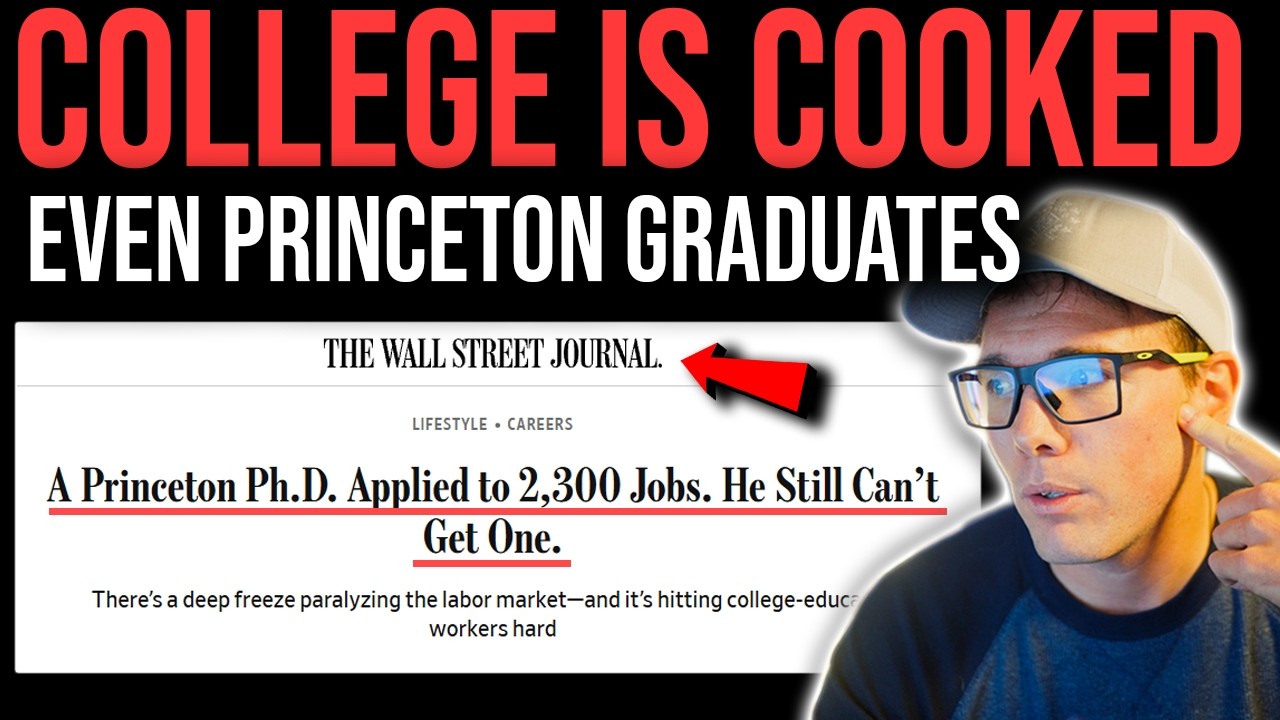
A Princeton PhD has reportedly applied to more than 2,300 jobs and still remains unemployed.
He has a doctorate in chemical engineering, attended Princeton and Rice, worked on research cited in connection with the Nobel committee, and has applied everywhere from research fellowships and pharmaceutical positions to software engineering and food-service jobs.
So how does someone with credentials like that send out thousands of applications and still struggle to get hired?
That’s what we’re talking about in this video.
The job market has changed.
A college degree, master’s degree or PhD can still be extremely valuable for careers where the education is required, but credentials alone no longer automatically separate somebody from everyone else applying.
More people have degrees.
More candidates have similar qualifications.
AI gives everyone access to enormous amounts of information.
And companies ultimately want to know something much simpler:
What problem can you solve for them?
What can you create?
What can you improve?
And what can you do that another similarly qualified applicant cannot?
We’re talking about education inflation, overqualification, the 2026 job market, AI, PhD unemployment, resumes, networking, personal branding and why sending thousands of nearly identical applications may not be the solution.
We also look at the temporary work this candidate did training AI systems using his chemical-engineering expertise, the problem with relying entirely on credentials, and why workers increasingly need to demonstrate their abilities rather than simply list qualifications.
Because if 100 applicants have similar education and experience, the question becomes:
Why you?
That can mean better resume positioning.
Specific accomplishments and outcomes.
A portfolio.
A personal brand.
Projects.
Creative problem solving.
A stronger understanding of how your skills apply to an actual business problem.
And being able to clearly communicate all of that.
You shouldn’t need an Ivy League PhD just to get a decent job.
But an Ivy League PhD doesn’t automatically guarantee one either.
What do you think?
If someone can send out more than 2,300 applications with credentials like these and still struggle to get hired, is the bigger problem the job market, the application strategy, the value of degrees, or some combination of all three?
Got a news tip or correction? Let us know
If you got something out of this, please chip in to keep this site running, or subscribe to go ad-free.
9 views