by C Hamilton
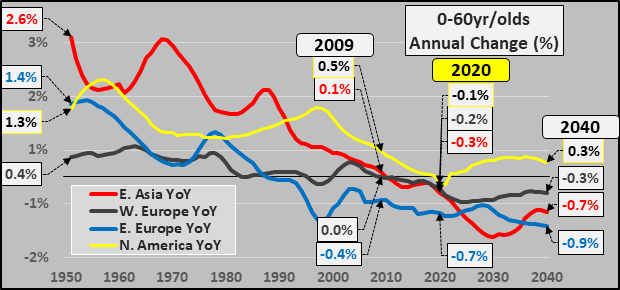
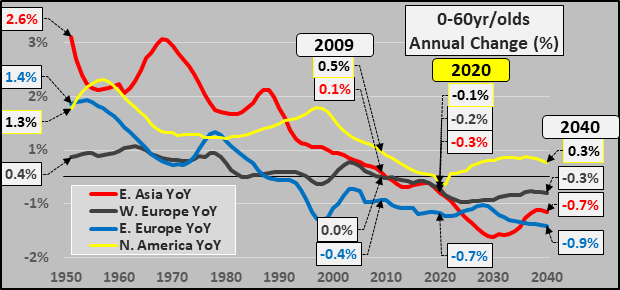 Below is what this looks like on an annual change basis in millions of persons. Noteworthy is 2009 was the gateway from centuries of secular growth to what is now decades or perhaps centuries of secular decline. 2020 is really the jumping off point, as a period of minor under 60yr/old population declines ends, and the downside speed accelerates in these four regions (particularly China in East Asia). In 2020, the global population of consumers will decline by 5 million. By 2030, the decline will be “at least” 17 million annually. Why “at least”? This data from the UN assumes birth rates and total births in these four regions far above what was observed in 2018 and 2019 and these UN assumptions of rising fertility and births is projected through 2040. Since 2007, birth rates and total births are significantly breaking to the downside, particularly in 2019…and the difference in these four regions was over 2 million fewer births in 2019 alone and the delta is only growing over time.
The actual declines in the under-60 population will likely be in excess of 20 million a year by 2030. Simply put, in 2020, we are looking at a 0.2% to 0.3% annual decline in consumers with the jobs, income, savings, and/or access to credit to consume. By 2030, the annual decline will be up to 0.7% to 0.8%. It is very hard to grow when you are shrinking…and all the poor and third world nations are dependent on the demand growth among these four consumer regions for their growth. You can see the problem (unless you are paid quite handsomely not to see it).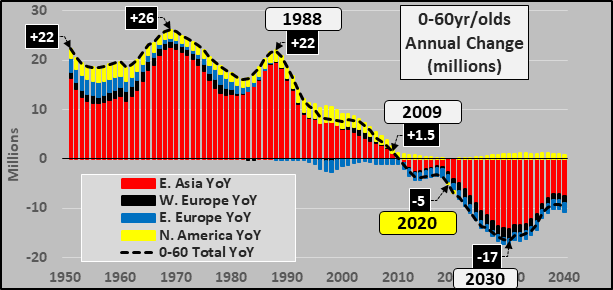 Strangely, the Federal Reserve and like central banks, in conjunction with federal governments, are making money ever cheaper with the aim of a continuation in global productive capacity…in the face of fast declining populations that do all the consuming. We are officially in a period of fiscal lunacy in the face of depopulation among the global consumer base.