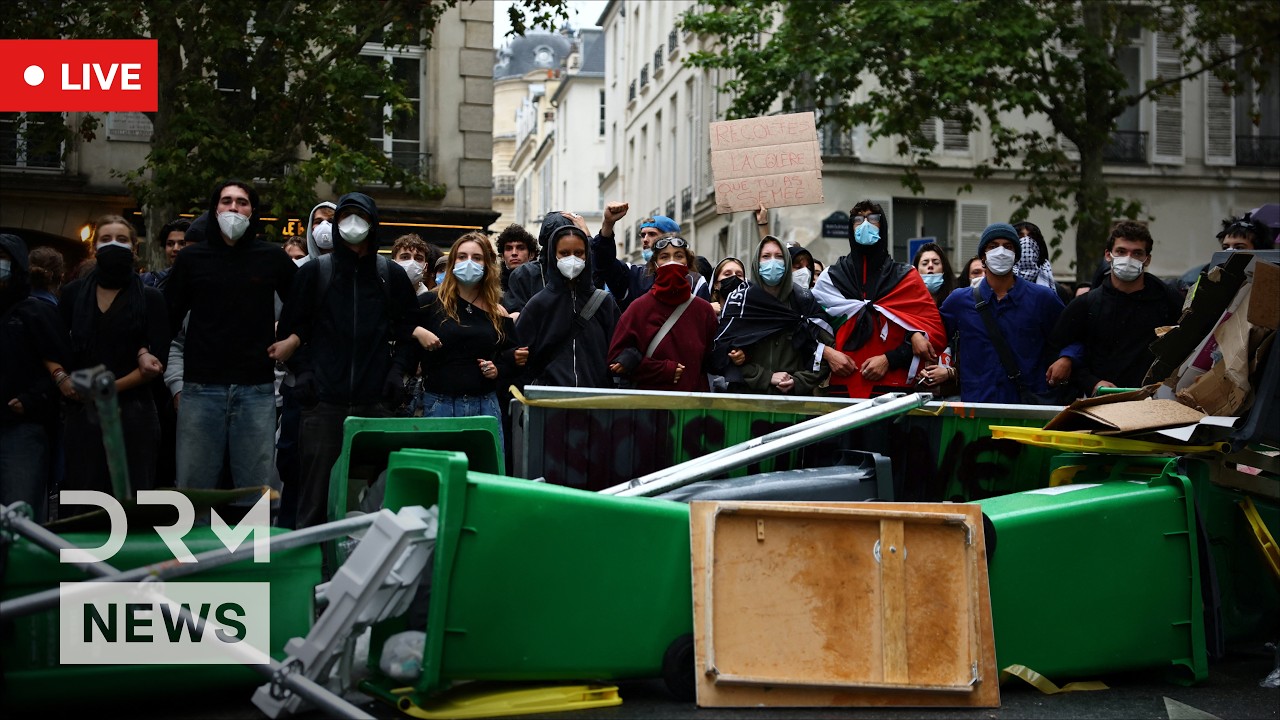
The French student protests are officially about education, but the anger underneath them is broader.
For three weeks, French students have blockaded schools across the country over teacher shortages, overcrowded classrooms, deteriorating buildings, long schedules and a university admissions system they believe can determine their futures. On October 8, police fired tear gas at students in Paris, while hundreds of schools remained disrupted. More than 6,600 people have been arrested since the protests began.
One French student interviewed by Le Monde put the broader fear directly into words: climate disasters, artificial intelligence taking all the jobs and uncertainty about the country’s political future.
That is the part worth watching.
A generation is spending years being told to study, get qualifications and prepare for the workforce while the workforce they are preparing for is changing underneath them.
And France is not alone.
In Spain, tens of thousands have protested in dozens of cities over housing costs, evictions and the inability of young workers to afford an independent life. Rents have risen roughly 80% in a decade, according to The Guardian.
In Italy, students have begun occupying schools and universities under the slogan “Let’s do as in France,” protesting education funding, deteriorating buildings and rising living costs. Belgium has seen clashes between police and students over similar education and funding issues. Greece, Ireland, Germany and Austria are also seeing student mobilization around education costs, funding and cuts.
Then there are the broader Gen Z protests.
In Nepal, youth protests over corruption and economic frustration forced the government from power in 2025. The International Labour Organization has since linked poor job prospects and the lack of decent work to growing political frustration among young people in Nepal, Bangladesh and Sri Lanka.
The pattern is not that every protest is secretly an AI protest.
It is that young people are increasingly angry about the future they are being offered.
Education doesn’t guarantee a good job.
A good job doesn’t guarantee housing.
And now AI is threatening some of the entry-level work that traditionally allowed young workers to get their first foothold.
Stanford researchers found that employment among 22-to-25-year-olds in AI-exposed occupations was 19% below the level expected relative to less-exposed workers.
The Census Bureau found employment among 22-to-24-year-olds in the most AI-exposed industries fell 12% over the 10 quarters after ChatGPT’s introduction, with fewer new hires driving much of the decline.
That creates a dangerous political feedback loop.
Fewer entry-level jobs means fewer young people establishing careers.
Fewer careers means weaker household formation and less ability to buy homes.
More expensive housing and education increase dependence on government.
Weak employment reduces tax revenue while increasing pressure for government assistance.
Governments then have to spend more at precisely the moment their finances are already under pressure.
France is already showing the collision.
The government wants to answer student demands with more teachers and repairs while simultaneously trying to control its deficit and reassure bond investors. Prime Minister Sébastien Lecornu has acknowledged the spending problem and promised solutions that can actually be funded.
If AI accelerates the employment problem, this gets much harder.
The political response could shift from “how do we adopt AI faster?” to “how do we stop AI from destroying the jobs people need?”
That means regulation.
Restrictions.
Taxes.
Subsidies.
Guaranteed income proposals.
Protection for workers.
And eventually, pressure against the companies building the technology.
That is where the AI investment boom could run into the political system.
AI stocks are currently priced for enormous future growth, while the economic and political costs of automation are only beginning to appear.
If the public backlash grows at the same time that investors start questioning AI infrastructure spending, the damage would not necessarily stop with Nvidia or the largest AI companies.
It could hit the broader market.
And if governments respond to mass unemployment with enormous stimulus while tax receipts weaken, long-term Treasury yields do not have to fall as much as investors might expect from a recession. More borrowing can collide with weaker government revenue and heavier spending.
That would leave investors facing an ugly combination:
AI destroying jobs.
Young people protesting.
Governments spending more.
Tax receipts weakening.
Deficits growing.
Long-term yields staying elevated.
And expensive AI stocks getting repriced.
Gold would be sitting on the other side of that trade.
Consumer staples would have a different advantage: people can stop buying speculative technology stocks, but they still need food, household products and basic necessities.
The French protests are not proof that global riots are coming.
But they are an early warning of what happens when a generation starts believing that education, work and housing no longer lead to the life it was promised.
If AI makes that feeling worse, the backlash may eventually be aimed at much more than schools.
Not financial advice.
Got a news tip or correction? Let us know
If you got something out of this, please chip in to keep this site running, or subscribe to go ad-free.
0 views