Something strange is happening with Coca-Cola.
The company is doing fine.
Actually, really fine.
Second-quarter revenue rose 7% to $13.4 billion.
Organic revenue grew 6%.
Global unit case volume jumped 5%.
Comparable EPS increased 11%.
And Coca-Cola raised its full-year outlook.
So this isn’t a story about Coke falling apart.
It’s almost the opposite.
Investors have decided Coke is one of the places to hide.
And they’re paying up for it.
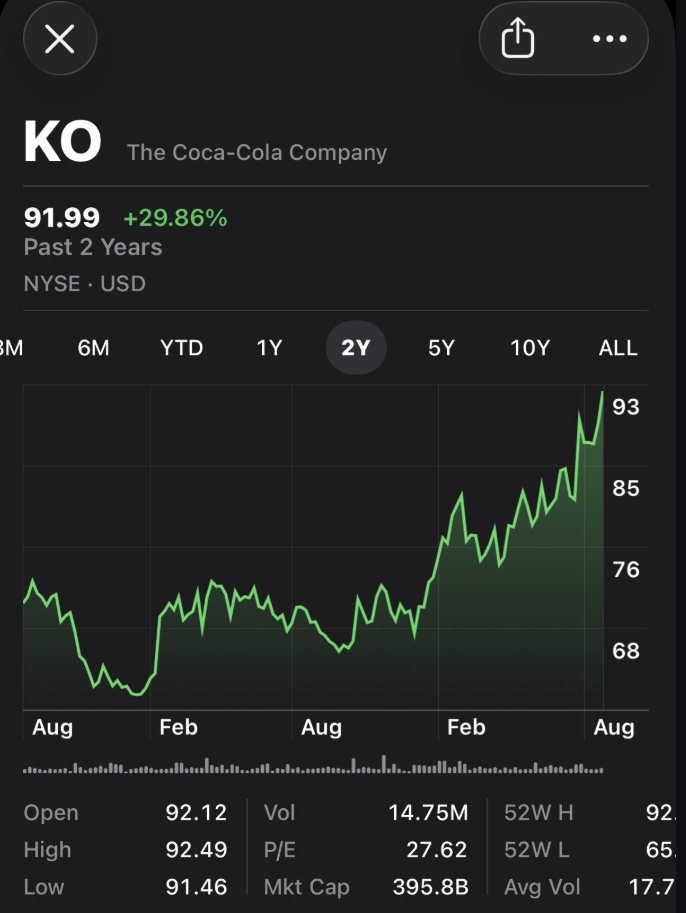
The stock recently hit an all-time high around $91.87 and is up more than 30% this year.
Now look at what you’re getting for that price.
Coca-Cola is trading around 27x earnings.
The dividend yield is only about 2.3%.
And the interesting comparison from the Reddit discussion is this:
KO is trading at a higher P/E than some companies growing dramatically faster.
One commenter pointed out that Meta trades at a much lower multiple despite growing revenue around 30%, while Coke is expected to grow earnings around 8%.
That’s the part I would focus on.
Because 27x earnings isn’t automatically expensive.
If Coke were growing 25% or 30%, nobody would care.
But Coke isn’t a 30% growth company.
It’s a mature global beverage company.
A fantastic one.
One of the best consumer brands ever created.
But still a mature company.
And that’s where the math gets uncomfortable.
If you pay 27 times earnings for an 8% growth business, you’re making a pretty big bet that investors will continue paying roughly the same premium for that 8% growth.
That’s not impossible.
But it leaves less room for disappointment.
And the dividend tells the same story.
Coke’s dividend is now yielding around 2.3%.
That’s not terrible.
But you’re buying a defensive dividend stock while accepting a yield that’s well below what you can get from long-term government bonds.
The 10-year Treasury is around 4.7% right now.
So the investor buying Coke at $91 isn’t just saying:
“I trust Coca-Cola.”
They’re also saying:
“I am willing to accept a much lower current income yield because I believe Coca-Cola deserves this premium.”
That’s a very different trade.
And here’s where I think the Reddit discussion gets it right.
The company can remain excellent while the entry price becomes terrible.
Someone in the thread calculated that when Coke gets this expensive relative to its historical valuation, long-term returns fall toward roughly 5% annually, compared with more than 8% at more normal valuations.
Another commenter made the same point from the dividend side:
The company can be perfectly healthy.
The dividend can be perfectly safe.
The entry point can still be bad.
That’s a much better way to think about this than “Coke is overvalued.”
Because Coke doesn’t need to crash.
It doesn’t need to miss earnings.
It doesn’t need consumers to abandon soda.
It doesn’t even need the business to disappoint.
The stock could simply spend several years growing earnings while the valuation comes back down.
And suddenly your “safe” investment produces mediocre returns.
That’s happened before with defensive stocks.
The irony is that the more people use Coke as a shelter from expensive technology stocks, market volatility and economic uncertainty, the more expensive that shelter becomes.
And Coke is giving investors plenty of reasons to love it right now.
Volume is up 5%.
Revenue is up 7%.
Margins are expanding.
EPS is up double digits.
The brand remains enormously powerful.
That’s exactly why this is interesting.
The bullish case isn’t wrong.
It’s just already sitting in the price.
At around $91, you’re not discovering Coca-Cola.
Everyone already knows Coca-Cola is great.
You’re paying a premium for everyone else’s belief that it will remain great.
That’s a dangerous distinction for a dividend investor.
Because when you buy a boring company at a cheap valuation, you can make money from both earnings growth and the valuation becoming more normal.
When you buy that same company at 27x earnings, you need earnings growth to do almost all the work.
And if the multiple contracts?
Your return can get crushed even while the business keeps delivering.
That’s why I think the most interesting question isn’t:
“Is Coca-Cola a good company?”
Of course it is.
The question is:
“How much are you paying for the privilege of feeling safe?”
Because right now, Coke isn’t just selling soda.
It’s selling safety to investors.
And safety gets very expensive when everybody wants it at the same time.
Got a news tip or correction? Let us know
If you got something out of this, please chip in to keep this site running, or subscribe to go ad-free.
33 views