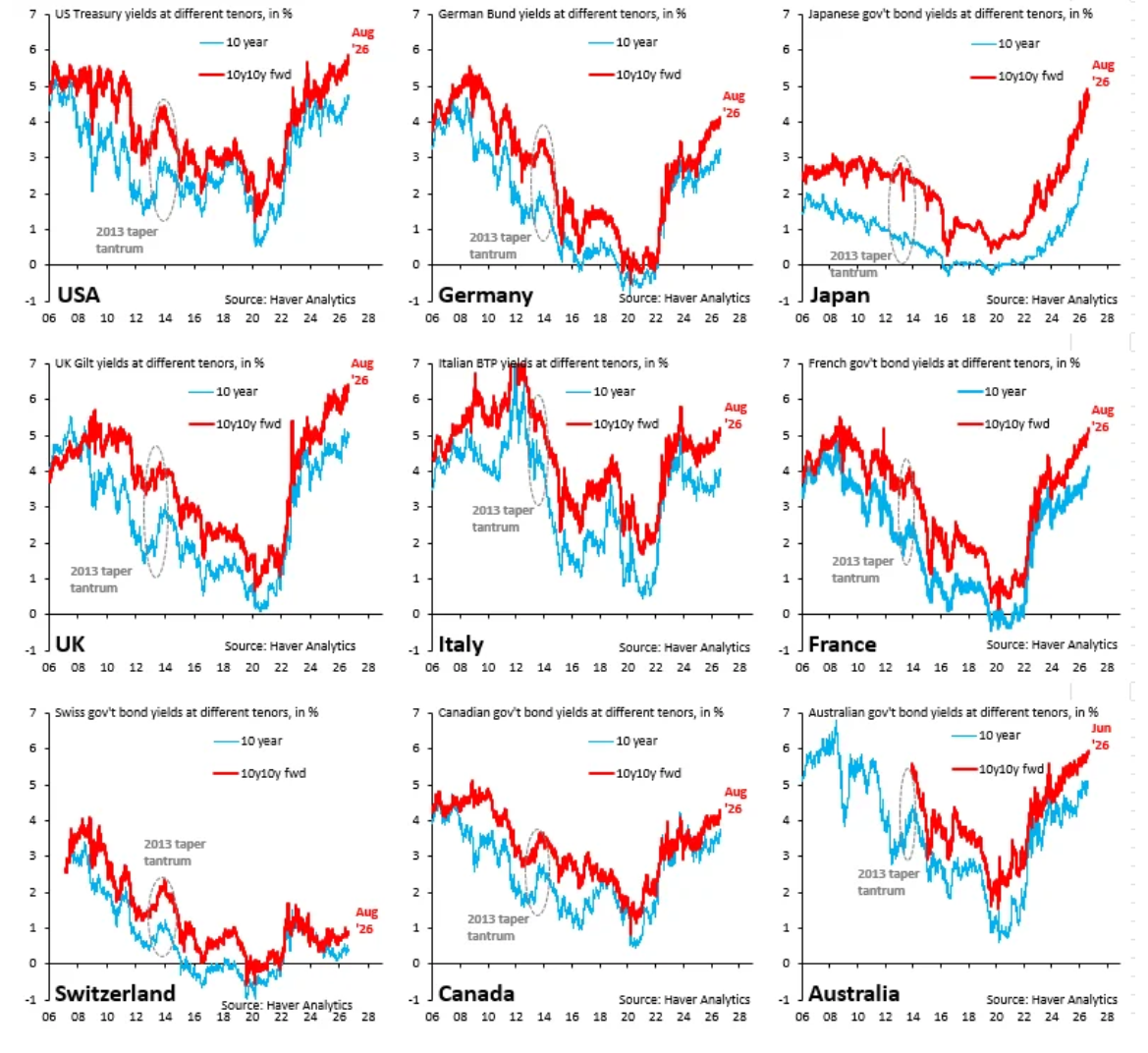
Something is happening in the bond market that deserves much more attention.
It’s not just the United States.
Long-term government yields are rising across the major economies.
The U.S. 30-year Treasury has been above 5%, reaching its highest level since 2007.
Japan’s 10-year yield is approaching 3%, around a three-decade high.
Germany’s 30-year yield recently hit 3.79%, the highest since 2011.
France’s long-term yield is approaching 5%, its highest level in 18 years.
And this is happening while governments are carrying enormous debt loads and preparing to issue even more.
When countries run out of fiscal space, the yield curve steepens, so gov'ts issue more short-term debt. They also claim markets are irrationally pushing up yields
byu/RobertBartus inEconomyCharts
That’s the part that bothers me.
Because if this were only a U.S. problem, you could point at Washington and say:
Too much debt.
But when the U.S., Japan, Germany, France and the UK are all dealing with pressure in their long-term bond markets, something broader is happening.
The market is demanding more money to lend to governments.
And governments don’t get to simply tell the bond market what interest rate they want.
They need buyers.
This is what the “fiscal space” discussion is really about.
A government can borrow heavily when investors are willing to lend cheaply.
But once yields rise, the same debt becomes much more expensive to carry.
And that creates a nasty feedback loop.
More deficits → more bonds → more supply → higher yields → higher interest costs → even larger deficits.
The problem gets worse when inflation is still elevated.
Because central banks can’t simply crush rising yields with unlimited bond purchases without risking another inflation problem.
The IMF’s Kristalina Georgieva just warned that bond yields are rising globally while disinflation has stalled, and called for credible plans to deal with deficits and debt.
That’s a pretty important combination.
High debt.
High borrowing costs.
Sticky inflation.
And governments that still need to spend.
Now look at Japan.
Japan spent decades operating with extremely low interest rates.
That made its enormous debt burden much easier to carry.
Now the 10-year yield is approaching 3%.
And Reuters reported this week that 57% of economists surveyed expect the Bank of Japan to raise its policy rate to 1.25% in September, with many expecting additional increases afterward.
That changes the math for the entire Japanese financial system.
Japan isn’t suddenly bankrupt.
The point is that the cost of carrying the debt is changing.
Germany has a similar problem from a different direction.
Berlin is increasing defense and infrastructure spending while Germany’s 30-year borrowing cost has climbed to levels not seen since 2011.
Germany’s planned bond issuance could reach €400 billion in 2027, according to Commerzbank.
Across the eurozone, Barclays expects roughly €1.54 trillion of gross bond supply in 2027.
That’s a lot of government debt competing for investor money.
And then there’s Britain.
UK government debt is approaching £3 trillion, roughly 94% of GDP.
Its estimated fiscal headroom has already fallen from £24 billion in March to around £17 billion.
So when people say a country is “running out of fiscal space,” they don’t mean the government literally has no money left.
They mean something much more dangerous.
The government is losing the ability to respond to the next crisis without making its debt problem worse.
Imagine another recession hits.
Normally the government responds with spending.
But if bond yields are already high, spending more means issuing more debt at expensive rates.
Imagine inflation comes back.
Normally the central bank raises rates.
But higher rates increase the government’s financing costs.
Imagine the economy weakens while inflation remains sticky.
Now monetary policy and fiscal policy are pulling in opposite directions.
That’s where the situation gets ugly.
And there is another layer.
The bond markets are connected.
Bank of America recently estimated that European long-term rates have absorbed a significant amount of the term premium coming out of the U.S. Treasury selloff.
Its estimates showed roughly 25 basis points transferred into German 30-year yields, 39 basis points into French bonds and 36 basis points into UK gilts.
So this isn’t five completely separate bond problems.
Investors are comparing governments against each other.
If U.S. Treasuries offer higher yields, Japanese investors have more reason to keep money at home.
If Japanese yields rise, Japanese institutions have less reason to send capital overseas.
If European governments issue huge quantities of bonds, they have to compete for the same global pool of capital.
And if everyone needs to borrow more at the same time?
The price of money goes up.
That’s the part I think investors are underestimating.
For years, governments could borrow enormous amounts because interest rates were extraordinarily low.
That environment made huge debt loads look manageable.
Now we’re entering an environment where governments are competing with each other for capital while inflation, defense spending, energy shocks and aging populations are all pushing spending higher.
Global public debt is already around 95% of world GDP, roughly $110 trillion, according to recent estimates.
That’s the backdrop.
And the really uncomfortable question is what happens if long-term yields keep rising even after central banks start cutting short-term rates.
Because then governments have a problem they can’t solve simply by saying:
“The Fed will cut.”
The market may not care.
The short rate can fall.
The 10-year can stay high.
The 30-year can stay high.
And the government still has to refinance its debt.
That’s why I’m watching the global long end, not just the U.S. 10-year.
If American yields rise because America has a fiscal problem, that’s one thing.
If American, Japanese, German, French and British long-term yields are all rising because investors everywhere are demanding more compensation to hold government debt…
that’s a completely different problem.
Because then the issue isn’t just Washington.
It’s the entire post-2008 debt model.
Governments got accustomed to cheap money.
Central banks got accustomed to suppressing yields.
Investors got accustomed to bonds acting as a reliable hedge.
Now the bond market is starting to say:
We’re going to charge you more.
And if governments can’t bring deficits down, they eventually have only a few choices.
Cut spending.
Raise taxes.
Accept slower growth.
Allow inflation to run hotter.
Or pressure central banks to absorb more government debt.
None of those choices are painless.
That’s why the $40 trillion U.S. debt number is only one piece of the story.
The bigger story is happening across the world.
The bond market is repricing government debt.
And if that continues, the next financial problem may not start with a bank.
It may start with governments discovering that the market has finally decided their borrowing isn’t as cheap as it used to be.
Got a news tip or correction? Let us know
If you got something out of this, please chip in to keep this site running, or subscribe to go ad-free.
72 views