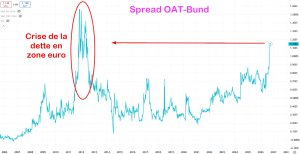
It was only on the 21st of this month that I looked across La Manche to France and we were right to be concerned because to coin a phrase the heat is on.
…it’s continuing to widen on the OAT-Bund spread We’re approaching 115 bps (1.15%) (Alexandre Baradez )
He also produced a rather revealing chart.

So back to the levels of the Euro area crisis and the days when the then ECB President Mario Draghi said this.
Within our mandate, the ECB is ready to do whatever it takes to preserve the euro. And believe me, it will be enough.
That led to Mario Draghi being one of the heroes of the Euro area although in an extremely important area we see he was completely wrong.
Not only if you look over the last 10 years but also if you look at it now, you see that as far as inflation, employment, productivity, the euro area has done either like or better than US or Japan.
Those words on the 26th of July 2012 were replaced by his words in the Draghi Review of September 12th 2024.
First – and most importantly – Europe must profoundly refocus its collective efforts on closing the innovation gap
with the US and China, especially in advanced technologies.
In fact he was reflecting on the words of Dr Isabel Schnabel which you may note covers the period that he back in 2012 claimed that the Euro area was doing well.
Between 1995 and 2007, annual growth in GDP per hour surged measurably in the United States, whereas it slowed and diverged in the euro area.
This is important as it has led into the problems faced by France today. The European elite and establishment heaved a sigh of relief at the actions of Mario Draghi but whilst he fixed one area they were asleep on economic growth. It was not just the United States they fell behind as Mario Draghi himself confessed in his 2024 Review.
Chinese competition is becoming acute in industries
like clean tech and electric vehicles, driven by a powerful combination of massive industrial policy and subsidises,
rapid innovation, control of raw materials and ability to produce at continent-wide scale.
As you can see the rhetoric of 2012 has been replaced by confessions of failure versus the US and China in 2024. Indeed as I pointed out on August 24th it has got worse since.
Corporate spending on new equipment and facilities in the US is projected to increase 40 per cent in real terms between 2021 and the end of next year, according to forecasts from Oxford Economics……The US surge compared with a real-terms increase of just 12 per cent in the euro area, while German business investment is expected to have all but stagnated over the same period.
ECB President Lagarde
We can come right up to date as here are the words of ECB President Lagarde at the European Parliament yesterday
AI could significantly enhance Europe’s productivity, competitiveness and living standards. But it will also affect – and to some extent is already affecting – investment, labour markets and inflation, and it therefore also matters for monetary policy.
Europe has a real opportunity to harness this technology. But success is not automatic. We need to seize the benefits, while managing the risks appropriately.
Actually if you look at her track record her arrival on the AI scene may well mean that it is on its way out. But if we move on from that we see the same old problem. Those creating the “benefits” will find that they have a statist bureaucracy “managing the risks appropriately”. I can almost hear the AI developers leaving to the US and China.
On the road I have described since 2012 it is the relatively statist France which has seen its economic growth fade out, as I pointed out on the 21st of this month.
But the real issue to my mind is the fact that over the previous year GDP growth was a mere 0.3% and as 0.7% was at the end of last year unless something changes it could easily get worse.
So this section has echoed The Beatles with Mario Draghi singing the Paul McCartney lines and the real world joining with John Lennon.
And I’m doing the best that I can (fool, you fool)I admit it’s getting better (better)A little better all the time (it can’t get no worse)
The ECB
The role of the ECB is especially relevant on two counts. The first is that if we look at the news from France this morning at least another interest-rate rise looks to be on its way,
Year-on-year, the harmonized index of consumer prices is projected to rise by 3.4% in September 2026, following a 2.6% increase in August. Month-on-month, it is projected to fall by 0.4%, after a 0.7% increase the previous month.
Let me jump to the bit which will concern the ECB.
Services inflation is projected to increase slightly, primarily because the seasonal decline in prices for accommodation and transportation services is expected to be less pronounced than in September 2025.
Also we have seen the ECB fail to act on “Le Spread” when one might reasonably have expected it to do so. It has a former French finance minister as its President and the Draghi era favoured Italy. Yet not only has there been inaction we have seen a signal of trouble which is the ongoing rumours that ECB President Lagarde will leave early. As she has a track record of leaving a sinking ship ( think record IMF loans to Argentina) this poses a question especially as her term does not have long to go. Plus it would seem she is not the only one.
I’m delighted to announce the appointment of Isabel Schnabel as IMF Financial Counsellor, effective Jan. 4, 2027. Her distinguished record, including at the ECB, and leadership in research and policymaking will be invaluable to the Fund. ( @KGeorgieva)
So we see that those in charge suddenly seem to want to be somewhere else which is not entirely reassuring! I did think that Dr, Schnabel had a chance of being the next ECB President but it is clear she thinks she knows better. Thus the chances of ECB intervention have declined as its leaders are busy with their own futures leading to a situation described like this.
Le spread is unstoppable – now at 120 I asked panelists at a recent investor conf what was the RED ALERT KLAXON level : I got answers between 150 & 200 I’m still not sure what triggered this very specific recent spike. (Johannes Borgen)
As he is usually a sober and measured observer it has rather echoed. Maybe people think that the famous phrase from Christine Lagarde in March 2020 was her actual view.
Lagarde: We are not here to close spreads, there are other tools and other actors to deal with these issues. (ECB)
Comment
As you can see things have really rather escalated and we can take another perspective because in bond yield terms the UK is the leader of a pack that no-one wants to lead. But the spread between the UK and French ten-year which was 1.35% as recently as May 11th is now 0.6%. A factor in this is the maths of the situation.
Well, the arithmetic is truly unpleasant for France with such high debt levels. With debt at 120% of GDP, and nominal GDP growth at 3%, an average borrowing cost of 4-4.5% would need a primary surplus of roughly 1.5% of GDP to keep debt/GDP constant. Primary deficit is 3%. (Luis Garicano)
I am always cautious about taking such derivative numbers too literally as for example today’s higher inflation number may lead to higher nominal GDP growth. But does anyone think that is a good thing? But there is also a point being made here…..
Got a news tip or correction? Let us know
If you got something out of this, please chip in to keep this site running, or subscribe to go ad-free.
0 views