Travel is supposed to make you feel better.
Take a break.
Clear your head.
Make memories.
Escape your routine.
So why does the vacation bill follow you home for months?
In 2026, Americans planning a vacation that requires a flight or paid lodging expected to spend an average of $3,940.
That’s not the total cost of some extravagant luxury vacation.
That’s the average.
Flights and lodging alone.
Then add food.
Rental cars.
Uber.
Parking.
Baggage.
Seat assignments.
Attractions.
Tips.
Travel insurance.
Airport food.
Hotel fees.
That $3,940 can turn into $5,000 surprisingly fast.
And suddenly the relaxing vacation has created a financial problem.
NerdWallet found that 35% of people who charged their 2025 summer travel expenses to a credit card still hadn’t paid off the balance when surveyed in 2026. Seventy-four percent of those who used credit cards didn’t pay the vacation off immediately.
Think about that.
You take a seven-day vacation.
The vacation ends.
You go back to work.
The vacation doesn’t.
The credit-card bill comes with you.
And 2026 travelers are doing it again.
84% planned to use credit cards for at least some travel expenses.
Nearly one-quarter said they would charge travel expenses and not pay them off right away.
Some planned to use buy-now-pay-later services.
Some planned to use personal loans.
Some planned to use cash advances.
Some planned to use payday loans.
We have reached the point where people can finance the experience of relaxing.
That’s insane.
And then we wonder why people are stressed about money.
NerdWallet’s September 2026 financial survey found 46% of Americans regularly stress about their debt balances.
So imagine somebody already worrying about debt.
They decide they need a vacation because they’re stressed.
They spend $4,000.
They put part of it on a credit card.
They come home.
Now they’re still stressed.
Except they also owe $4,000.
What exactly did the vacation solve?
This is where the whole “experiences over things” slogan starts falling apart.
A thing you buy can be stupid.
An experience can be stupid too.
And an experience that leaves you making minimum payments isn’t automatically more meaningful because you took a picture in another country.
People act like spending money on travel is somehow morally superior to spending money on material things.
Why?
If you spend $4,000 on a television, people might tell you that’s irresponsible.
Spend $4,000 flying across the world, staying in hotels and eating restaurant food for a week?
“Good for you. You’re making memories.”
You still spent $4,000.
Your bank account doesn’t care whether the money went toward a television or a hotel in Barcelona.
Neither does your credit-card company.
And there is another problem.
The cost doesn’t stop when you book the trip.
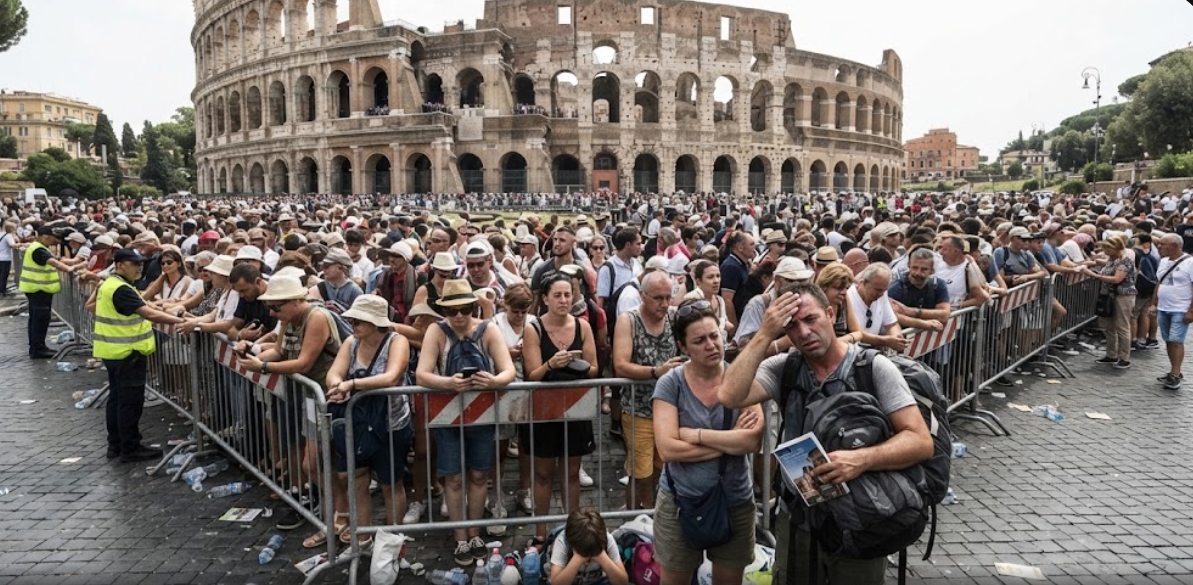
Travel encourages spending because every decision happens in a temporary environment where you don’t want to feel cheap.
You’re already there.
What’s another $40?
The nicer room is only $75 more.
The better seat is only $35.
The excursion is only $120.
You flew all this way.
You might as well do it.
You don’t want to tell your family you flew to Italy and skipped the tour because it cost $90.
You don’t want to tell your kids they’re not doing the attraction because the tickets are $250.
You don’t want to sit in the hotel eating a sandwich from a supermarket because you already spent $1,500 getting there.
So you keep spending.
That’s how a $3,000 trip becomes a $5,000 trip.
Not because you got scammed.
Because every individual expense feels small compared with the cost you’ve already committed.
And then comes the psychological trap.
You can’t even admit the trip sucked.
You spent too much money.
You took time off work.
You planned it for months.
You dragged the family through an airport.
You waited in lines.
You got overcharged.
You barely slept.
You came home exhausted.
Now you’re supposed to say it was amazing.
Because admitting you hated it means admitting you spent thousands of dollars to make yourself miserable.
So the vacation gets rewritten.
“The food was amazing.”
“The crowds were part of it.”
“The hotel was charming.”
“We were exhausted, but it was worth it.”
Maybe.
Or maybe people are just really uncomfortable admitting buyer’s remorse when the purchase cost $4,000.
And the financial pressure can extend well beyond the trip.
If that money came from savings, you’ve reduced your cushion.
If it came from a credit card, you’ve created debt.
If it came from a loan, you’ve created a monthly payment.
If it came from money you could have invested, you’ve given up whatever that money might have earned.
If you were already living paycheck to paycheck, the next unexpected bill doesn’t care that you just had an amazing sunset in Santorini.
The car breaks.
The furnace dies.
Your kid needs something.
Your hours get cut.
Now that $4,000 sitting in your bank account would look pretty damn good.
This is why I don’t buy the idea that travel automatically reduces stress.
Sometimes it does.
But sometimes you’re taking financial stress and putting a passport on it.
And the travel industry has a perfect answer for that too.
Use points.
Open a travel card.
Finance the vacation.
Buy now and pay later.
Upgrade.
Split the payment.
Book now.
Figure out the money later.
At some point, you’re not buying a vacation.
You’re borrowing against your future paycheck to purchase the feeling that you’re enjoying your present life.
That’s a terrible trade for somebody who doesn’t have the money.
And the most ridiculous part is that staying home is free.
Not literally free.
Your mortgage or rent still exists.
Your electricity bill still exists.
But you don’t have to pay $700 for a flight to enjoy your Saturday.
You can sleep until noon.
Cook something you actually like.
Take your kids somewhere nearby.
Go to the beach.
Watch a movie.
See friends.
Read a book.
Do absolutely nothing.
And nobody is charging you a resort fee for sitting on your own couch.
There is no baggage fee.
No cancellation fee.
No foreign transaction fee.
No airport parking.
No $19 airport sandwich.
No connecting flight.
No lost suitcase.
No hotel checkout.
And no $4,000 bill waiting for you when the “self-care” is over.
Travel can be worth every penny when you genuinely want the experience and can comfortably afford it.
That’s not the argument.
The argument is that we’ve taken something optional and turned it into a requirement for a supposedly fulfilling life.
You haven’t traveled enough.
You need to see the world.
You need experiences.
You need memories.
You need to get out of your comfort zone.
Maybe.
Or maybe you need to stop spending money you don’t have because Instagram convinced you that staying home means you’re wasting your life.
Because there is one experience nobody markets nearly as aggressively:
Having enough money that your vacation doesn’t create a financial problem when you get home.
That sounds pretty relaxing to me.
Got a news tip or correction? Let us know
If you got something out of this, please chip in to keep this site running, or subscribe to go ad-free.
0 views