U.S. Is Poised to Impose Tariffs on EU, Canada, Mexico Metals we have always been saying this was happening for weeks now get ready for the retaliatory tariffs and escalation… we think this is very neg global risk especially equities
— FxMacro (@fxmacro) May 31, 2018
Do not look at this chart. Seriously, it is not healthy for you. $DB RECORD LOW pic.twitter.com/a67MfezuZY
— Alastair (@StockBoardAsset) May 31, 2018
Dow Jones stopped going up when .@NewYorkFed started reducing balance sheet pic.twitter.com/tzaJGvOO0d
— Alastair (@StockBoardAsset) May 31, 2018
https://twitter.com/OccupyWisdom/status/1001994544152502272
https://twitter.com/MacroTechnicals/status/1002272865885048832
WHY CORPORATE PROFITS MAY BE WEAKER THAN THEY SEEM
via Justin Lahart
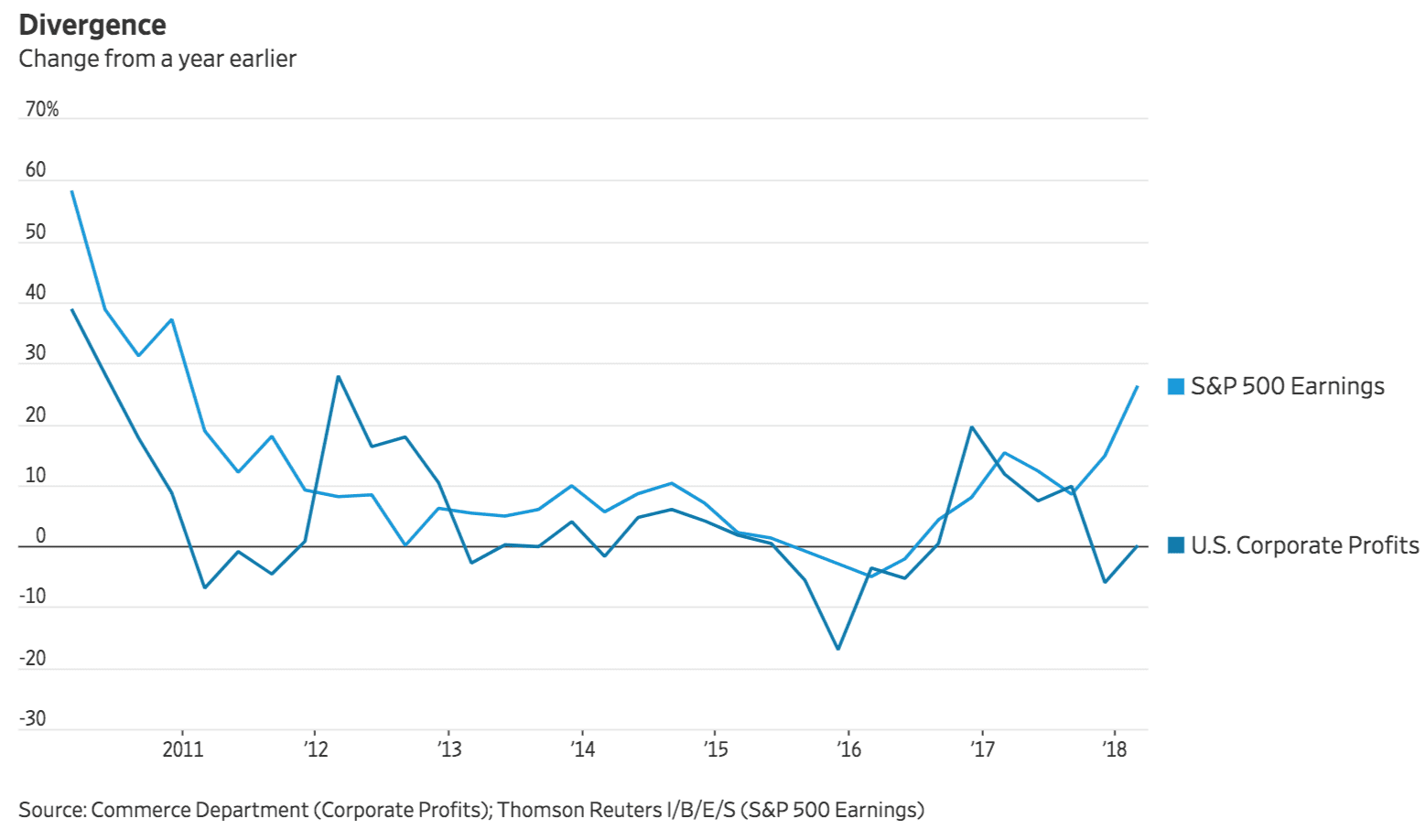
According to companies, profits were great in the first quarter. According to government statistics, not so much.
Profits for companies in the S&P 500 grew a stunning 26.3% in the first quarter compared to a year earlier, according to Thomson Reuters I/B/E/S. That measure, which is used by investors, benefited from a strong global economy, a weakening dollar and, most of all, a cut in the corporate tax rate to 21% from 35%.

But a Commerce Department measure of corporate profits, released alongside gross-domestic-product data on Wednesday, showed that profits rose by just 0.1% in the first quarter from a year ago. Take away the tax-cut benefit, and the numbers were worse: Before accounting for the benefits of the tax cut, profits were down by 6%. These numbers are the only ones that show the impact of the tax cut, which created a divergence of the pre- and post-tax numbers.
There are a number of important distinctions between the profits S&P 500 companies post and the government profit figures. Government figures largely exclude companies’ overseas operations. The government figures include all U.S. companies, not just big public ones.
This is a really interesting chart. https://t.co/kTWq8ZN1Ce pic.twitter.com/mvW3xI3Rsf
— Joe Weisenthal (@TheStalwart) May 31, 2018
Got a news tip or correction? Let us know
If you got something out of this, please chip in to keep this site running, or subscribe to go ad-free.
1 view