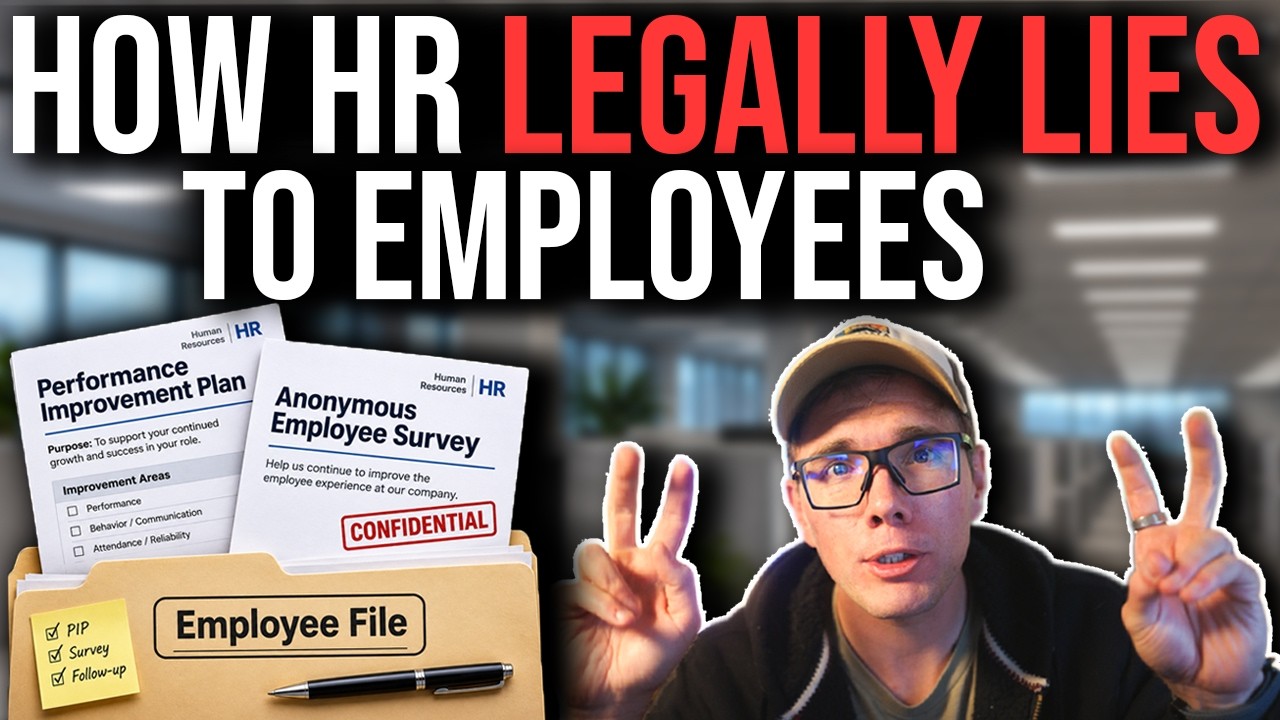
HR tells employees to speak up, be honest, use the open-door policy, complete anonymous surveys and trust that conversations will be handled confidentially.
But HR works for the company.
That changes what all of those things actually mean.
In this video, we’re going through what HR is really doing when employees complain, why managers suddenly start documenting everything, how performance improvement plans can become paper trails, what “confidentiality” actually means at work, why anonymous employee surveys may reveal more than employees realize, what exit interviews are really used for, and why HR often acts as the buffer between executives and employees.
You can work somewhere for years with good reviews and suddenly every conversation becomes an email.
Every tiny mistake becomes a formal issue.
Goals suddenly become hyper-specific.
Your manager starts writing messages like they’re preparing evidence for court.
Then comes the performance improvement plan.
Employees hear “performance improvement plan” and assume the company is creating a structured process to help them improve.
But sometimes the more important thing being created is documentation.
The same dynamic shows up in employee surveys.
Companies ask for honest feedback because the information is useful.
Leadership can learn which teams are unhappy, which policies people hate, whether compensation is becoming a retention problem and how far they can push something before employees actually start leaving.
And “anonymous” does not always mean nobody can infer who wrote something — especially on small teams or when an employee describes a very specific incident.
Then there’s the friendly language.
People Operations.
People Experience.
People Partner.
Open-door policy.
Confidential conversation.
Those phrases make HR sound like an independent advocate for the employee.
It isn’t.
HR can absolutely help an employee when protecting that employee also protects the company from legal, compliance or business risk.
But that still doesn’t make HR your personal representative.
HR works for the employer.
So if you’re going into a complaint, investigation, PIP, exit interview or sensitive conversation with HR, understand who is sitting on the other side of the table and what their job actually is.
What’s the wildest thing you’ve ever seen HR do at a company?
Let me know below.
Got a news tip or correction? Let us know
If you got something out of this, please chip in to keep this site running, or subscribe to go ad-free.
0 views