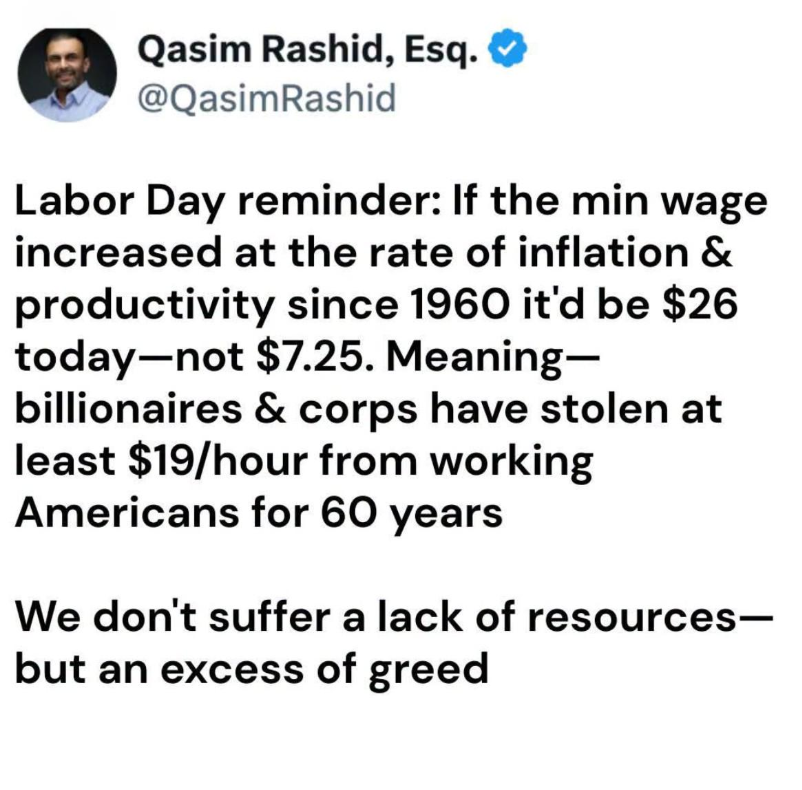
There is one number in this graphic I wouldn’t defend.
The claim that $1 in 1960 should equal $26 today is too simplistic.
Several people caught that immediately.
$1 in 1960 is roughly $11.40 today just from inflation.
So if we’re going to make the argument, let’s make the better one.
Because inflation isn’t the whole story.
Productivity matters too.
Workers today have computers.
Software.
Industrial machines.
Automation.
Better logistics.
Faster communication.
Better equipment.
A worker can produce far more with those tools than a worker could in 1960.
That’s the point behind the argument.
If output per worker rises dramatically over decades, where does the extra value go?
Some goes into lower prices.
Some goes into new investment.
Some goes into profits.
Some goes into higher wages.
And some gets captured by whoever has the bargaining power.
That’s where the discussion gets messy.
One commenter pointed out that nominal GDP per person went from roughly $3,000 in 1960 to almost $90,000 in 2025.
That’s about a 30x increase.
The argument isn’t that every worker should literally be making 30 times their old wage.
It’s whether workers should have received a larger share of the enormous increase in economic output.
And there is another problem with the meme.
The federal minimum wage isn’t the wage most workers actually earn.
Only a small fraction of workers are paid exactly the federal minimum.
Many states have much higher minimums.
Many employers pay more because they have to compete for workers.
So using the federal minimum wage alone makes the picture look worse than it really is.
But that doesn’t kill the larger argument.
It actually makes it more interesting.
Because now we’re talking about bargaining power, not just minimum wage.
If one company in a town is the only realistic employer for a certain type of worker, that worker doesn’t have much leverage.
If three companies are fighting for the same worker, the worker has more leverage.
If moving to another city means losing your health insurance, selling your house, changing your kids’ schools and starting over, that isn’t much leverage either.
And if an industry consolidates into a handful of huge companies, the worker may technically have freedom to leave while having very few realistic alternatives.
That’s where the phrase “free market” starts getting complicated.
A market can have millions of consumers and still give very little power to the individual worker.
You can technically quit.
But if every comparable employer pays roughly the same, how much freedom did you really have?
This is also why I don’t think the entire wage problem can be explained with one villain.
It’s not simply:
“corporations are greedy.”
It’s not simply:
“the government caused inflation.”
It’s not simply:
“workers didn’t learn new skills.”
It’s all of these forces pushing against each other.
Technology made workers more productive.
Companies paid for much of that technology.
Government determines a huge amount of the rules.
The Fed determines the value environment money operates in.
Corporate consolidation can reduce competition for labor.
And workers negotiate for their share of the output.
The part worth arguing about is how that split changed over the last 60 years.
Because saying “workers are more productive” doesn’t answer the question.
It creates the question.
More productive for whom?
Got a news tip or correction? Let us know
If you got something out of this, please chip in to keep this site running, or subscribe to go ad-free.
89 views