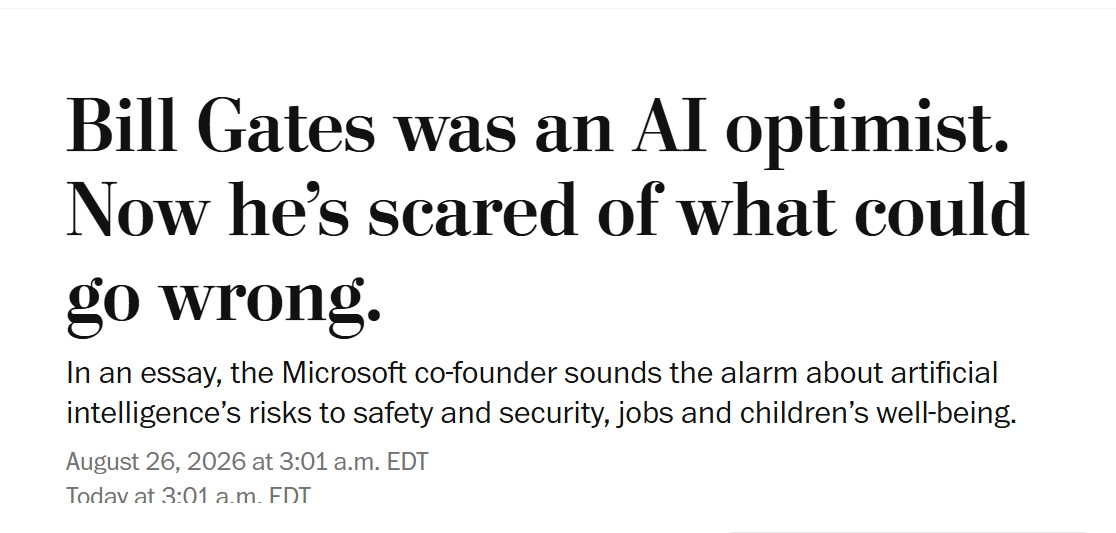
This is a pretty big change from Bill Gates.
For years, Gates was one of the biggest technology optimists in the world.
Now he’s saying he is scared of what AI could do and wishes the technology would move more slowly.
Not some random tech critic.
Bill Gates.
And his solution is even more interesting.
He wants certain jobs to be “Human Reserved.”
Basically, jobs that society decides should stay human even when a machine could technically do them.
He also wants taxes on AI and robots.
Think about how strange that sounds.
For decades, the basic promise of technology was:
Machines make us more productive.
Workers become more productive.
The economy gets richer.
New jobs appear.
Everybody eventually benefits.
Now one of the people who helped build the technology is saying:
Maybe we need to deliberately stop AI from taking some jobs.
And he’s not only talking about factory workers.
Gates says law, customer service, software development, medicine and manufacturing could all face major disruption within the next decade. He is especially worried about young workers because entry level jobs could disappear before new workers even get a chance to enter those professions.
That last part is important.
What happens when companies stop hiring people for the jobs where people normally start their careers?
You don’t just lose today’s job.
You lose the first rung on the ladder.
And Gates is now saying governments aren’t prepared for this.
His essay is nearly 5,800 words.
His message is basically that there is no real plan for what happens when AI starts doing large amounts of human work.
He also wants AI taxes and robot taxes to help pay for retraining and social programs.
Again, think about what that means.
If AI makes a company more productive while allowing it to employ fewer people, the company gets the savings.
But the government loses payroll taxes.
Workers lose income.
And somebody still has to pay for healthcare, Social Security, schools and everything else that used to be funded by millions of people earning wages.
That’s the part of the AI debate I think gets ignored.
AI can make the economy more productive and still make the economic system worse for millions of people.
Those two things can happen at the same time.
Gates is now openly worried about exactly that.
And his warning isn’t only about employment.
He is also worried about AI making cyberattacks, fraud and biological threats easier, while AI companions and heavy AI use could hurt children’s development and critical thinking.
There is already a pretty big gap between how people feel about AI and how the industry talks about it.
A recent Pew survey found 52% of Americans say they are more concerned than excited about AI, up from 37% in 2021.
And now Gates is basically saying the same thing.
The technology may be incredibly useful.
It may create huge amounts of wealth.
It may improve medicine, science and productivity.
But that doesn’t automatically mean ordinary people win.
That’s the part worth paying attention to.
The question is no longer just how powerful can AI become?
It’s becoming:
What happens to an economy when the technology becomes better at doing the work than the people who need that work to earn a living?
And now Bill Gates is asking governments to figure that out before it happens, not after.
Got a news tip or correction? Let us know
If you got something out of this, please chip in to keep this site running, or subscribe to go ad-free.
51 views