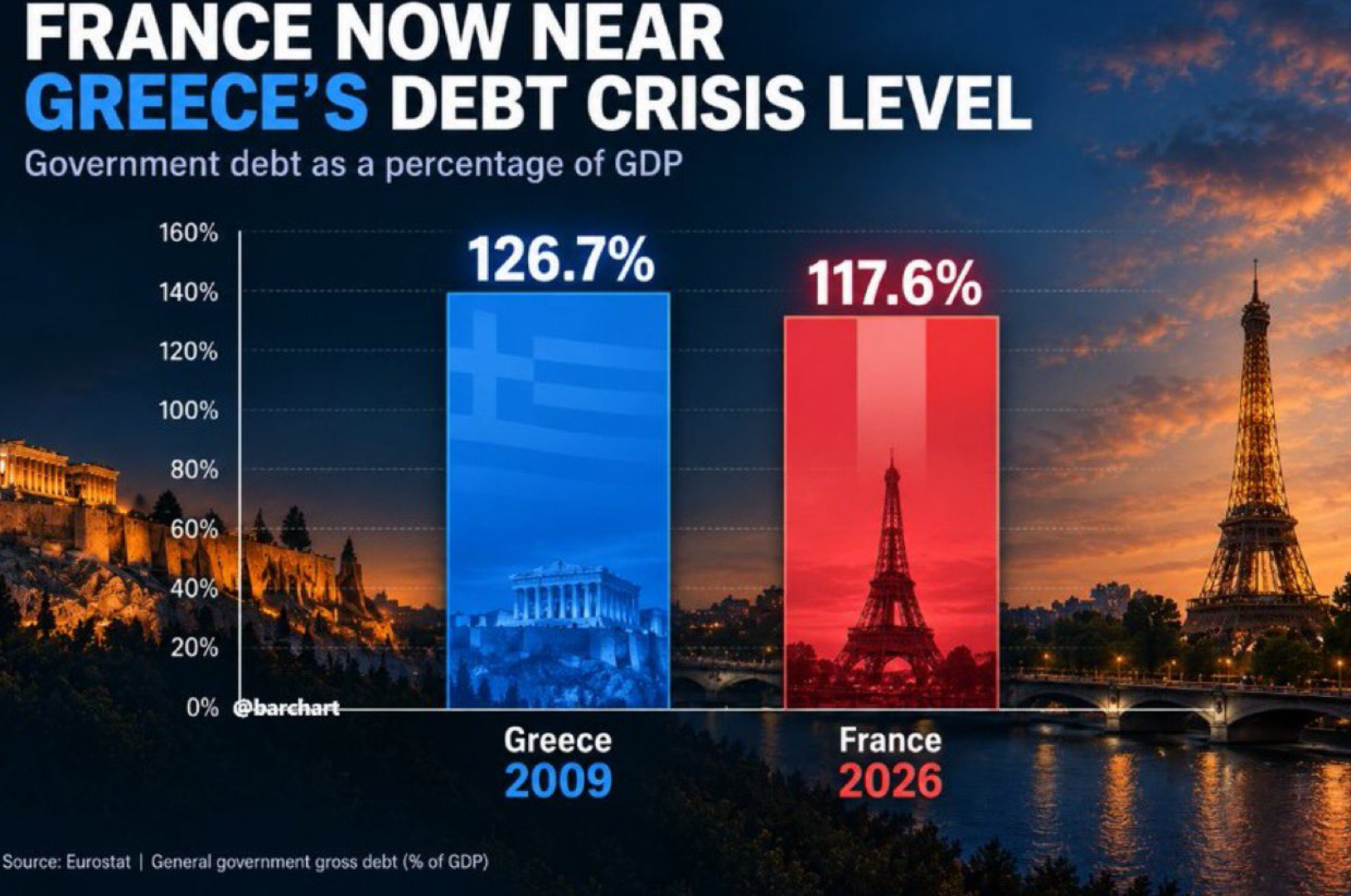
France is staring into a sovereign debt crisis, European credit markets are showing cracks, and the AI boom is piling up trillions in infrastructure commitments. What happens when governments can no longer borrow cheaply while the companies driving the next technological revolution need ever more debt to keep expanding? The French crisis could be what bursts the AI bubble which it could be the spark that exposes how fragile the entire financing machine has become. If bond yields keep climbing and lenders start pulling back, the AI reckoning could arrive much faster than Wall Street expects.
The cost of buying default insurance on Meta and Nvidia debt has just hit a RECORD high.
Trading in credit default swaps on AI giants have SOARED from under $2bn in July to over $9bn in September.
THERE'S CLEARLY TROUBLE IN PARADISE. pic.twitter.com/OEnKCfiJkU
— Steve Hanke (@steve_hanke) October 21, 2026
Brutal report on CoreWeave.
– LLM Revenue growth slowing
– ROIC of 8.9% below cost of borrowing
– Revenue per MW is 30% below hyperscalers
– 2028-2030 EPS 50-70% below consensus
Meanwhile, its bonds trade as junk, CDS spreads record highs &
$CRWV
down 67% since highs.
What happens if it gets worse?
Very likely a bailout.
Nvidia may be the most likely candidate given Jensen’s commitment to it.
But, this would be an admission that Nvidia has just been buying their own product all along…
Brutal report on CoreWeave.
– LLM Revenue growth slowing
– ROIC of 8.9% below cost of borrowing
– Revenue per MW is 30% below hyperscalers
– 2028-2030 EPS 50-70% below consensusMeanwhile, its bonds trade as junk, CDS spreads record highs & $CRWV down 67% since highs.
What… pic.twitter.com/GyoDnzGetb
— Nic (@puckrin) October 22, 2026
France's debt level is now closing in on Greece's 2009 level at the onset of the European Sovereign Debt Crisis 🤯 👀 pic.twitter.com/YvxZ9OR9zc
— Barchart (@Barchart) October 21, 2026
Brad Gerstner (creator of Trump Accounts) was back on CNBC today shilling SpaceX and the AI bubble, even though he's sold all of his AI stocks that aren't locked up.
35% of Brad's $SPCX shares unlock this weekend.
You literally can't make this sh!t up… https://t.co/Gdi7WMMG1N pic.twitter.com/R9520XAgnD
— Financelot (@FinanceLancelot) October 21, 2026
French bond spreads hit their widest level since the eurozone debt crisis
https://www.reuters.com/world/europe/french-debt-risk-premium-reaches-euro-zone-sovereign-crisis-levels-2026-10-22/
France’s 10-year yield reached 5.14%, while its premium over German Bunds widened to 173.58 basis points, the highest since 2011. The political crisis is now being reflected directly in borrowing costs. The spread remains below levels associated with the most acute phase of the previous eurozone crisis.
AI-related debt concerns coincide with widening European corporate credit spreads
https://www.wsj.com/finance/investing/french-government-bond-yields-rise-spread-widens-as-treasury-yields-fall-e67fc4cd
The European iTraxx Crossover credit-default-swap index reached 329 basis points, its highest in nearly seven months. At the same time, French yields surged even as U.S. Treasury yields fell. This is evidence of rising credit risk in Europe, but the divergence shows that France’s stress has not yet translated into a global sovereign-bond selloff.
Investors become more selective about AI financing
https://www.axios.com/2026/10/21/ai-funding-neoclouds-debt
Investors are demanding clearer paths to profitability from AI infrastructure companies, particularly debt-dependent cloud providers. The market is scrutinizing financing arrangements in which large technology companies support smaller AI businesses through investments, leases, future purchases or loan guarantees. That interconnectedness could transmit losses beyond the original borrower if demand disappoints.
S&P warns that hyperscalers’ AI liabilities may be larger than disclosed
https://www.investing.com/news/stock-market-news/top-hyperscalers-likely-to-have-more-ailinked-debt-than-now-known-4958070
S&P Global estimates the six largest hyperscalers could spend more than $7 trillion on data centers and AI infrastructure between 2025 and 2030. It warns that guarantees and other financing commitments may obscure the full exposure. S&P has not called for immediate ratings changes, but it identifies unsustainable spending or weaker AI revenue as conditions that could change its assessment.
Credit protection costs spike for AI infrastructure companies
https://www.investing.com/news/stock-market-news/ai-credit-default-swap-spreads-widen-sharply-4950549
Five-year credit-default swaps on Oracle widened to 288 basis points, while CoreWeave’s exceeded 1,000 basis points, according to market data cited by Reuters. Investors are demanding much more protection against default for some companies tied to the AI buildout. This is one of the clearest signs that the financing risk exists independently of France’s political crisis.
IMF identifies an AI correction and rising sovereign yields as possible systemic triggers
https://www.investing.com/news/economy-news/imf-cites-ai-slowdown-spiking-yields-as-looming-global-market-risks-4945345
The IMF explicitly identified an AI-driven asset selloff and a sharp rise in government bond yields as plausible near-term catalysts for financial instability. It warned that leverage and forced selling could amplify either shock. The report gives your thesis a documented macroeconomic mechanism, rather than requiring an assumption that the French crisis must cause an AI crash.
Yellow Vests plan a new Paris march as the French budget crisis deepens
https://www.investing.com/news/world-news/french-government-faces-fresh-test-as-yellow-vests-mobilise-4962362
The Yellow Vests planned a major march for Saturday, October 24, while student groups called for more education spending. The movement is reviving grievances over living costs and declining public services just as the government struggles to pass a budget. Renewed unrest could intensify pressure on French bonds if investors conclude that fiscal consolidation is becoming politically impossible.
Michael Burry warns the stock market is obviously in the first stage of a 2008-style crash — with just 6 to 9 months to go until stage 2
https://www.msn.com/en-us/money/investment/michael-burry-warns-the-stock-market-is-obviously-in-the-first-stage-of-a-2008-style-crash-with-just-6-to-9-months-to-go-until-stage-2/ar-AA2fGzML?cvpid=d608059c4f1e4a48dcfc1712deef2572
Got a news tip or correction? Let us know
If you got something out of this, please chip in to keep this site running, or subscribe to go ad-free.
2 views