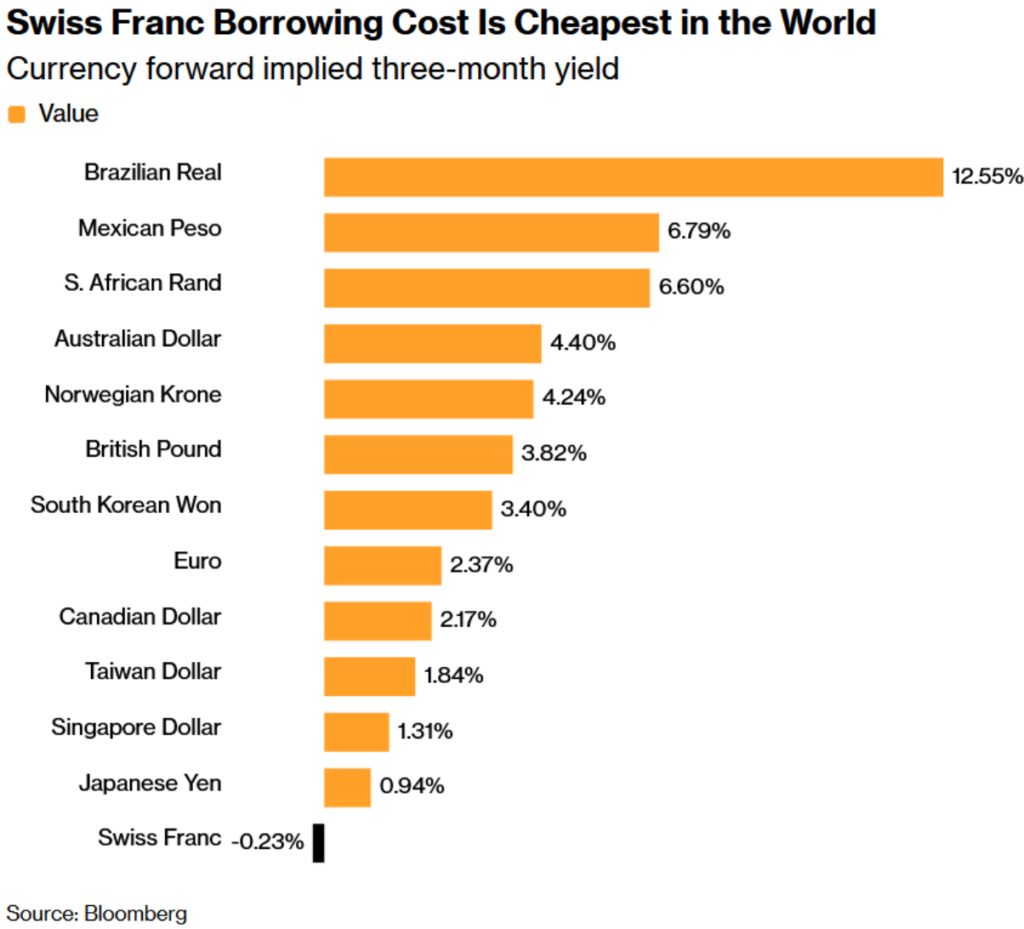
Something interesting is happening in the world’s favorite cheap-money trade.
Investors are starting to look at the Swiss franc instead of the yen as a funding currency.
And the reason is pretty simple.
The yen is becoming a headache.
Japan has a 1% policy rate.
Switzerland is at 0%.
Japan is facing rate-hike expectations, currency intervention and the possibility that Japanese institutions start bringing more money home.
Switzerland, meanwhile, has been openly uncomfortable with a strong franc and has said it is willing to intervene to weaken it.
So from a carry trader’s perspective, the franc suddenly looks cleaner.
Borrow francs.
Sell them.
Buy something with a higher yield.
Collect the difference.
The yen used to be the obvious choice.
Now there’s a catch.
Japan and the U.S. are trying to make the yen stronger.
That is terrible for someone whose entire trade depends on borrowing yen and betting against it.
Reuters reports that the recent intervention has already pushed yen short positions lower, with those positions getting closer to the level of outstanding franc shorts. Investors are beginning to discuss rotating funding positions toward CHF.
But here’s where I think the story gets more interesting.
The Swiss franc has been a cheap funding currency for years.
So why didn’t it become the world’s giant carry trade instead of the yen?
Scale.
The yen is vastly more liquid.
The BIS says the yen was involved in 16.8% of global FX transactions in its latest survey.
Global FX trading reached about $9.6 trillion a day.
The yen isn’t just cheap.
It is deep enough for enormous positions to be built without immediately moving the market.
And Japan has something Switzerland doesn’t have on the same scale:
decades of savings being pushed overseas.
Japanese banks.
Insurers.
Pension funds.
Asset managers.
Households.
All sitting on enormous pools of capital while domestic interest rates stayed ridiculously low.
That money went abroad looking for yield.
U.S. Treasuries.
Foreign bonds.
Stocks.
Credit.
Emerging markets.
The yen became the plumbing underneath a huge amount of global investing.
The Swiss franc never reached that scale.
And that creates an interesting problem now.
If investors start replacing yen funding with franc funding, the carry trade isn’t disappearing.
It’s looking for somewhere else to hide.
That matters.
Because the reason investors are moving isn’t that they suddenly love Switzerland.
They’re trying to avoid the risks attached to the yen.
Japan wants a stronger currency.
The BOJ may raise rates.
The U.S. and Japan have already intervened.
Meanwhile, Swiss rates are at zero and the SNB is comfortable with a weaker franc.
From a carry trader’s perspective, that’s a pretty obvious comparison.
But there’s another catch.
The franc is a safe-haven currency.
If markets really panic, the same investors borrowing francs today may suddenly need to buy francs tomorrow.
That’s how a carry trade gets ugly.
You borrow a currency because you expect it to stay weak.
Then everyone starts buying it.
Your funding currency rises.
Your trade loses money.
You rush to close it.
Your buying pushes the currency even higher.
That’s exactly the kind of feedback loop that makes carry trades dangerous.
So I don’t think the right takeaway is:
“The yen carry trade is dead.”
It’s not.
The yen remains one of the world’s most liquid currencies and is still likely to be a major funding currency.
The more interesting thing is that investors are already looking for an alternative.
And that tells us something.
The appetite for cheap leverage hasn’t disappeared.
The money still wants a low-cost funding currency.
Now it has to decide where to get it.
The yen has Japan.
The franc has Switzerland.
And both central banks have very different problems with their currencies.
Japan wants a stronger yen.
Switzerland wants a weaker franc.
That makes the Swiss franc unusually attractive for the trade right now.
But replacing the yen isn’t simple.
You can replace the interest rate.
You can’t instantly replace the liquidity, institutions, savings and decades of capital flows that made the yen carry trade so enormous.
That’s why I think this is bigger than a currency story.
The market isn’t abandoning the carry trade.
It’s shopping for a new funding source.
And if the yen really starts squeezing shorts while traders pile into CHF instead, we’re going to find out how much leverage was actually depending on cheap currencies staying cheap.
h/t Nic
Got a news tip or correction? Let us know
If you got something out of this, please chip in to keep this site running, or subscribe to go ad-free.
52 views